Our Big Escape
Keep Your Options Open
  • Home
  • Recipe Roundups
  • World Recipes
  • About Us
  • Contact
Category:

All Travel Trailer

9 Gilman Tunnels Dispersed Camping
All Travel Trailer

6 Dry Camping Sites Best Locators

by John - Laurel Rodgers July 9, 2022
written by John - Laurel Rodgers

One of the frequent questions we are asked is “How do you find Boondocking or Dry Camping Sites?”

The simple answer is that it’s not hard. In fact it’s easy. Our favorite, since we do love drones, is using one of our drones to lead the way. This is the best way we have found to avoid going up a dead end road with no way to turn the truck and trailer around.

Several national forests, along with the Bureau of Land Management (BLM) lands in the United States, have primitive campsites with no amenities. Usually, you are allowed to boondock anywhere within a national forest as long as there isn’t a sign stating otherwise.

As a result, it makes boondocking an excellent option for RV enthusiasts. You can follow forest access roads and find a location that will best suit your needs for great boondocking or dry camping sites.


Want more ideas to round-out your Road Trips?
A lot of great ideas are in these posts!

  • Our Top 10 Family Road Trips
  • 13 Easy Off Grid Vacation Tips
  • 6 Great Top Off Grid Travel Locations
  • The 10 Best Off-Road Adventures

However, not every place has allotted areas for boondocking and dry camping sites, making it relatively challenging to choose a great place. This tends to become more demanding among the newbies.

To help with that, we have compiled five ways to find boondocking and dry camping sites, making the whole process relatively easy even for a novice.

10 Tips for Every Beginner Boondocker (6)


6 Best Ways to Find Boondocking & Dry Camping Sites


check out our video


1. United States Forest Service (USFS) Website

If you are on the lookout for boondocking and dry camping sites, then the United States Forest Service website will be the best place for you. On the USFS Website, you will be able to find both free and paid boondocking and dry camping sites.

As you commence your search, you should consider looking for dispersed camping or wild camping. These are terms that you will probably come across a lot. As far as natural boondocking spots go in the United States, several are located on public lands, including BLM lands along with the National Forests.

When visiting the United States Forest Website, you will be able to find a relatively big green box located on the right side, titled ‘Find a Forest or Grassland’. While there, you should go ahead and select your state or the one you are heading to from the first drop-down.

Then it will narrow down your options in a second drop-down. Furthermore, if you are on the lookout for a specific area, you should consider selecting a forest that is near that particular location. However, you can go ahead and explore every option.

With your preferred forest selected, the website will automatically take you to its homepage. You will be prompted to choose your adventure; therefore, you should ensure that you click on the ‘Go Camping’ button. You will then go ahead and click on ‘RV camping’ or ‘Campground camping’ on your next set of options.


Want more ideas to round-out your Road Trips?
A lot of great ideas are in these posts!

  • Our Top 10 Family Road Trips
  • 13 Easy Off Grid Vacation Tips
  • 6 Great Top Off Grid Travel Locations
  • The 10 Best Off-Road Adventures

It would be best if you kept in mind that sometimes spots designed to accommodate RVs might be missed by jumping to the RV camping section immediately. Some homepages of a national forest might not be equipped with an option to choose your preferred adventure.

Then, you should go ahead and click on a recreation site. This menu would be on the left side of your page.

By doing so, you will be able to open up a sub-menu; you will then go ahead and select camping and cabins. As an individual who is looking for a free boondocking spot, you should click dispersed camping. In case that option isn’t available, boondocking will still be available.

However, you might be required to pay a small fee. In such cases, you will go ahead and click campground camping.

Here, you will come across descriptions of all Boondocking and Dry Camping sites that are available. Furthermore, you will be able to know how many sites there are and the limit on how long you can stay.

The website will also offer additional information such as the nearest town, nearest bathrooms, along with other essential stuff you will need to know.

It is highly recommended that you read through the details with utmost care since some areas feature designated campsites within dispersed camping areas. Usually, this is common in cases where measures have been placed to mitigate human impact within that particular area.

In places where these measures are in place, you will see brown posts with designated camping sites displayed.

2. Campendium.com Website & App

It will take a little research and effort to find boondocking and dry camping sites. Campendium is both an app and a website designed to make the whole process much more user-friendly. With Campendium, you will be able to find both paid, free, and privately owned boondocking and dry camping sites.

This website and app is setup to help you to find suitable overnight campsites and serene locations for extended camping. Compared to the USFS Website, Campendium is arguably intuitive, and it is capable of finding more than Forest Service Land. As a result, this makes it the best option for individuals who are looking for an array of options.

With Campendium, you will be able to filter your results. When visiting this site, all options will first appear on the map, including both paid as well as developed campgrounds. When it comes to boondocking, you should consider going for anything represented using a green pin.

There will be several options to sort out. However, you should click on all public lands for boondocking. If you want free spots, you should click on free.

Purple pins will indicate free spots that are ideal for quick overnight boondocking. However, it might not be suitable for weekend camping. They are actually best for use as resting stops as well as parking lots.

The best part of using Campendium is that it is equipped with user reviews. Once you have filtered and sorted through all your results, you can go through reviews in order to find out a site that will best suit your preference.

User reviews often include exact location, cell coverage, noise level, site quality, pricing as well as cleanliness. You should always note that these campsites’ conditions are often subject to weather and human activities.


Dispersed Camping

3. iOverlander for Dry Camping Sites

Just like Campendium, iOverlander is an excellent app and a website equipped with user reviews. This app and website is designed to help in reducing clutter and is fitted with several search filters. The app is also user-friendly and is equipped with a modern feel.

The best part is that you can use iOverlander for more than just boondocking. Campendium is designed to be a source of different types of campgrounds. While iOverlander is intended to serve the Overlanding community that requires locations and hostels in other countries.

If you are planning on boondocking in the United States, you will type in your ‘preferred area’, such as the state, in the iOverlander search box. You go ahead and filter under place type and select wild camping.

One of the most useful filters for a boondocking enthusiast in iOverlander under the required amenities is the ‘big rig friendly’. You can also filter out areas that haven’t been used within a certain period if you need to camp in places where someone has camped recently.

While most dry camping sites are not “big rig friendly” there are some around and this is the best way to located them.

For a fast overview, you might consider clicking on green pins. You can click on ‘more details’ for complete information and pictures. To check on the latest user review, you can click on the ‘latest check-ins’.

4. Google Map Satellite View

While on the lookout for boondocking and dry camping sites, websites and applications equipped with user reviews tend to be the best. However, when you are in an area with relatively few or zero reviews or struggling with internet connectivity, google map satellite view tends to be the best option.

When using Google map satellite view as an alternative to apps and websites, you should consider looking at the areas that surround you immediately. Usually, forest service land is regarded as a safe bet for boondocking as well as for dry camping sites.

However, it might not be the only option. It is a great place where you can start a search while driving. It would be best if you considered zooming into any light green patches present on a google map.

You should then turn on satellite view and start on the closest forest service road near your position. It would be best if you were looking for brown patches. Usually, the brown patches are a sign of clearings. Among trees, these clearing often denote campsites.

NOTE: You are looking at a location that is not in “real time”.

5. Our Favorite is Using Our Drones

We start out using Options 1 through 4 to determine a large area for boondocking. After the larger area we want has been picked and we checked on any regulations about flying our drone, we are ready.

Once we get into the BLM land, if we come to an interesting road we would like to investigate for an available camping site, we pull out the drone.

We are pulling a 20′ Geo Pro solar equipped trailer, so we don’t just turn up any old fire road. And instead of walking up the road for miles or unhooking the trailer and taking the truck up the road, (not recommended or allowed in most places) — we prepare the drone.

We want to check out the route to see if it’s passable — no sharp turns or deep gullies in the road. We are also checking if there is an outlet to another major road or if it has a large enough area we can turn around and come back out after we have stayed our time.


5 Top Boondocking vs Dispersed Camping Choices

6. Ask a Park Ranger

It might be an old-fashioned way of finding Boondocking and Dry Camping sites, but it’s still effective. You can always ask a park or forest ranger. Ranger service stations are accessible and often have the latest info.

In cases where there have been dangerous wildlife sightings or forest fires, a forest or park ranger will make you aware of the areas to avoid when giving you their choice of the best dry camping sites. They are also highly informed when it comes to locations where you are permitted to park or not allowed to park an RV.

Usually, road closures and weather can have a significant effect on the information you come across on the internet and through applications. However, most rangers are friendly and love helping all boondocking enthusiasts, and they will guide you to the best  Camping Sites.

Furthermore, the best boondocking spot can come as an insider tip from a park or forest ranger.

Tips for Choosing the Best Boondocking and Dry Camping Sites

Now that you know how to find boondocking and dry camping sites, choosing the best campsite for your needs is important. When selecting the best boondocking and dry camping sites, there are various significant factors you will need to address.

Some of these factors will totally depend on you, while others will be limited to the amount of boondocking locations available within your area. Therefore, it is highly advisable that you plan ahead and ensure that there will be a spot available for you to camp.

If you cannot find boondocking and dry camping sites within your area, you should consider coming up with a ‘Plan B’. Another significant factor you will need to keep in mind is the type of camping you prefer along with your travel needs.

You need to figure out if you are looking to go into the wilderness or just require a place to park for a night. By factoring this in, you will be able to narrow down your final destination with ease. It is recommended that you verify the place you will be camping allows dry camping legally

If you are planning on staying in a parking lot, you should consider calling the store ahead. For wilderness boondocking, it is recommended that you contact the appropriate local agency and verify whether boondocking is allowed and learn their rules and regulations for dry camping.

It is essential that you adhere to these tips in order to avoid a citation or getting fined while boondocking.

You should also consider looking for a campsite with a campfire ring or one that looks like it has just been used. This will help you lessen the human impact on the environment and aid in preserving the land while enjoying the beauty of nature.

While boondocking, it is a requirement that you pick up trash as well as observe fire restrictions for a safe and fun boondocking experience. Some boondocking locations enforce regulations on staying 14 days or less.

If you have ‘neighbors’ in the area, please be courteous about noise during your stay. By adhering to these essential tips, you are guaranteed to have a successful boondocking experience.

Final Verdict – Finding Dry Camping Sites

As a newbie to RV or van life, you will undoubtedly plan for boondocking at any given point. Boondocking can be challenging among newbies due to a lack of experience. However, by going through this article and adhering to the tips discussed here, you will find the whole experience pretty much enjoyable.

Remember, choosing the best boondocking and dry camping sites is not a simple task but it is an easy one. Please consider using the five practical tips discussed in this article as a guide.


You May Want to Join Our Boondocking Group on Facebook For More Information

You May Want to Join Our Campfire Recipes Group on Facebook For More Information

July 9, 2022 0 comments
0 FacebookTwitterPinterestEmail
Travel Trailer Accessories
All Travel Trailer

20 Great Travel Trailer Accessories (Updated 2022)

by John - Laurel Rodgers July 9, 2022
written by John - Laurel Rodgers

As an RV enthusiast, you probably understand that convenience is vital. This means you will have to grab a few but highly important stuff for use during your trip. However, it is never an easy task to choose the best boondocking travel trailer accessories. As a result, in this article, we shall be taking you through the 20 great best boondocking travel trailer accessories that are a must-have during your trip.

Boondocking

Travel Trailer Miscellaneous Accessories

Travel Trailer Accessories 1. RV GPS

Most individuals, particularly mop junkies, often claim that RV GPS isn’t an essential tool; however, you should avoid listening. It is recommended that you have an RV GPS equipped with inbuilt software specifically designed for RVs; such GPS is way superior to the traditional map.

Furthermore, various RV GPS systems are available in today’s market, each equipped with its unique feature. Therefore, you should always consider going for the one that will best suit your needs.


check out our video


Want more ideas to round-out your Road Trips?
A lot of great ideas are in these posts!

  • Our Top 10 Family Road Trips
  • 13 Easy Off Grid Vacation Tips
  • 6 Great Top Off Grid Travel Locations
  • The 10 Best Off-Road Adventures

Travel Trailer Accessories 2. Source of Power

When it comes to camping, having a reliable source of power is highly essential. This is highly essential, especially if you plan on boondocking in an area located relatively deep in the wilderness. The best and most reliable source of power is a solar panel compared to the traditional propane generator.

You will be able to save a significant amount of money, and in addition to that, solar panels are clean and produce no noise and fumes, making it best for camping. However, you need to ensure that your solar panels are working before heading off to the wilderness.

Travel Trailer Accessories 3. Sewer Hose Support

When boondocking, having a sewer hose is a must. In addition to that, investing in a sewer hose support aids in protecting your hose as well as make it relatively easy for everything to flow through the sewer hose. This means that there will be fewer chances for a messy situation while dumping.

Travel Trailer Accessories 4. Portable Water Hose

While boondocking, you will need clean and safe water for use and consumption. Therefore, investing in a portable water hose ensures that your water is free from chemicals, smells, or unpleasant odors. These hoses are relatively affordable and very easy to identify since they are equipped with pure white color.

Travel Trailer Accessories 5. Water Pressure Regulator

In addition to a portable water hose, you will require to invest in a water pressure regulator to regulate and offer you the right water pressure. If not, the forceful city stream may end up causing damage to the delicate plumbing system of your RV.

Fortunately, lie a portable water hose, an in-line water pressure regulator is pocket friendly and often costs less than $10. Compared to the repairing costs, investing in a water pressure regulator becomes affordable and boosts safety significantly.


Travel Trailer Accessories

Travel Trailer Accessories 6. Emergency Kit

As the old saying goes, better safe than sorry; you should always consider having an emergency kit while going into the wilderness. This is vital since boondocking always has ways of surprising even the best of prepared individuals with experience.

With an emergency kit on board, you will be able to keep you and your family safe while on the road, irrespective of the obstacles you may come across during your trip. In your emergency kit, you should consider having these vital products;

· First aid kit. Safety should always be your top priority, and with a first aid kit, you will be able to take care of minor injuries along with illnesses. You can purchase or make your own first aid kit; however, you should ensure that you have it the right way.

· Ice scraper. When boondocking, you will be very glad to have this tool with you. It always comes in handy when you camp in an area with ice or snow.

· Toolkit. This is a must-have kit; it is ideal for fixing little things in your car. It would be best if you considered investing in a well-rounded kit equipped with a nice case equipped with all vital pieces.

· A knife. You should invest in a good pocket knife. It is highly essential since it has an array of use in day-to-day life and emergencies.

· Wheel chocks. Usually, campsites are rarely perfect level. You should avoid runaway RV and invest in some wheel chock and always use them each time you park.

Most of the items discussed in this emergency kit are best for use during emergencies as well as in your everyday life. Therefore, as a newbie in boondocking, you should always consider investing in an emergency kit.

Travel Trailer Accessories 7. RV Cover

When the RV is off-road, it is highly recommended that you keep it covered in order to protect it against dirt, debris, along with another potential source of damage. To do that, you should consider keeping your RV in a covered storage facility. However, for the most boondocking enthusiast, this is never an option, and in that case, you will need to invest in an RV storage cover.

RV covers have been designed to offer maximum protection to your car against bird droppings, ultra-violet rays, along other hazards. Although it might not sound like a big deal, it will go a long way when it comes to extending your RV’s reliability.


Travel Trailer Accessories

Boondocking RV Travel Trailer Kitchen Accessories

The kitchen is the heart of every home, without any doubt, and your travel trailer is no exception. By investing in these kitchen supplies, you will be able to make your meal a special treat every time. Here are some of the best boondocking RV travel trailer kitchen accessories;

Travel Trailer Accessories 8. Instant Pot

Despite being a relatively small device, an instant pot should be your top priority when it comes t RV kitchen, and it is for a good reason. With an instant pot, you will be able to gain the ability to stew, sauté, bake, roast, ferment yogurt, and make perfect rice.

Furthermore, some individuals use instant pot to make skin lotion or dog food. Investing in an instant pot is vital, and you are guaranteed that anything you throw in it will always come put magically delicious.

Travel Trailer Accessories 9. Pot and Pan Set

When it comes to pots and pans, you should consider investing in the stackable ones in order to save space. This is highly essential since not even the most prestigious luxurious Class-A trailer is equipped with significant kitchen storage. In addition to cooking gear, you will need to come up with a way in which you can fit dry food in the same cabinet. To achieve that, you will need to invest in a stackable pot and pan set to help you kill two birds with a single stone.

Travel Trailer Accessories 10. Compact Ovenware

If you invest in a motorhome equipped with a conventional oven, you might find it less spacious compared to the one you use at home. To make your favorite muffins, you will; need to invest in compact ovenware that is sized into a smaller size.

Travel Trailer Accessories 11. Collapsible Dishwasher Tub

If you are in need of more space in your kitchen, you should consider investing in a collapsible dishwasher tub. Such dishwashers are designed of food-grade silicone that is not only bendable but also relatively easy to clean. This makes it a perfect accessory for your boondocking travel trailer. Note: You can save the water to use in flushing the toilet.

Travel Trailer Accessories 12. Reusable/Stackable Containers

Investing in reusable and stackable containers is ideal for storing and meal prep. Furthermore, they are suitable for both freezers as well as fridges. Reusable containers also offer you an opportunity to purchase dry goods in bulk, making it an effective method of saving money when it comes to the food bill. When not in use, they stack inside each other saving space.

Towing Accessories

When driving a boondocking travel trailer, it is best you invest in towing accessories. Here are some essential accessories ideal for boondocking travel trailers;

Travel Trailer Accessories 13. Electric Brake Controls

If you have a heft weight of trailer connected to your SUV, you understand that stopping can be a bit challenging. To help with that, you should consider investing in electric brake controls, which will improve the breaking process. Furthermore, it can be a legal requirement depending on your boondocking travel trailer’s size along with the state you are driving in.

Travel Trailer Accessories 14. Wheel Stabilizer

Even after applying your standard leveling blocks, trailers can still be a bit wobbly compared to their motor-coach counterparts. As a result, you will need to invest in a set of suitable wheel chocks. Usually, X-chocks are among the best as well as highly reliable chocks in today’s market and are designed to work with the natural motion of the tires instead of going against them. The best part is that they are relatively easy to use.


Travel Trailer Accessories

Other Vital Boondocking Travel Trailer Accessories

Investing in boondocking travel trailer accessories, you will be able to have an enjoyable boondocking experience. However, these accessories can tax your travel budget. Likely, not all RV accessories tend to be expensive, and also, not all affordable travel trailer accessories are total junk. Here are some fun and vital boondocking travel trailer accessories you might invest in;

Travel Trailer Accessories 15. High-pressure showerhead

Traveling with a personal bathroom on board is awesome. However, you might think with all the technologies equipped in an RV for the last century would include a nice and strong shower stream. This is usually not the case in several boondocking travel trailers. As a result, you should consider replacing the shower with a high-pressure showerhead, which will improve your shower experience and save a significant amount of water.

Travel Trailer Accessories 16. Internet access

In today’s world, getting by without internet connectivity tends to be relatively challenging for an extended period. Internet access is essential for staying in touch with friends and family as well as carrying out everyday chores such as online banking. Therefore, being online while on the road is vital. However, it has been challenging for individuals to stay online while since the invention of the internet in the 1990s.

Fortunately, with the increase in demand, most campgrounds have been designed to offer high-internet speed connectivity. While boondocking, you might consider camping in an area that provides internet access if you are in need of web surfing.

Some boondocking travel trailers come equipped with Wi-Fi extenders or repeaters that aids in strengthening shaky signal. If the internet is an essential accessory, you might consider investing in such boondocking travel trailers.

Travel Trailer Accessories 17. Reminders

When on the road with your RV, you might forget doing some vital chores such as checking your satellite antenna; such errors often happen among experienced campers. These errors can be dangerous or inconvenient if you don’t rectify them as soon as possible.

To help with that, you can invest in RV minders; these are set of slap bracelets warning that can be a stick in the steering wheel each time you set-up your camp. With these reminders, you will not forget to check up on your RV before you continue with your trip.

Travel Trailer Accessories 18. Extra Fire Extinguisher for Safety

It might not be sexy, but it is worth investing in. it is recommended that you equip your RV with an extra fire extinguisher. For the additional fire extinguisher, you might consider storing it in your bathroom if a fire starts while you are in there.

Travel Trailer Accessories 19. Headlamp for Night Emergencies

A headlamp will come in handy a lot; as a result, you should consider investing in a high-quality headlamp. With a high-quality headlamp, you will be able to tackle emergencies with ease, especially in the dark. Emergencies have a nasty habit of occurring at night.

Travel Trailer Accessories 20. Tire Pressure Monitoring System

Since you will be boondocking in the wilderness, investing in a tire pressure monitoring system is critical. With this tool, you will know when you are losing pressure before it becomes a significant concern. This is a crucial part of boondocking, which most individuals often ignore and regret later on.

If you are on the lookout for the best boondocking travel trailer accessories, we strongly recommend that you invest in the ones discussed in this article. As we conclude, we hope that you have found this article beneficial.


You May Want to Join Our Boondocking Group on Facebook For More Information

You May Want to Join Our Campfire Recipes Group on Facebook For More Information

July 9, 2022 0 comments
0 FacebookTwitterPinterestEmail
best tents for camping

10 Best Tents For Camping & Living Outdoors Full Time

by John - Laurel Rodgers June 25, 2022
written by John - Laurel Rodgers

If you are planning on living outdoors full time then you need to go over this research on the best tents for camping year round. There are many reasons why someone would choose to live full time in a tent. Obviously, there is the love of nature and the outdoors. But, had you ever thought of these reasons?

Save Cash Living Outdoors Full Time

The expense of living in a tent is a significant benefit. Compared to living in a home or even an apartment, it is far less expensive. Even though you will need to purchase a lot of materials, the entire cost will still be considerably less than the monthly costs of gas, rent, internet, and power.

Live Healthier Tent Camping Year Round

Studies have shown that spending a lot of time in the forest, sometimes known as “forest bathing,” can help you become healthier in a variety of significant ways. Your body’s internal control, immune system strength, and ability to take in more air are all aided by the phytoncides that plants release. Some people think that spending time outside can make you happier as well. Let’s not overlook the rise in vitamin D either.

Cut Back On Your Carbon Footprint

Living in a tent is one of the best things you can do if you want to lessen the influence you have on the environment and the globe. Living outdoors prevents you from consuming significant amounts of water, power, and other resources. Living in a tent can significantly reduce your carbon footprint and your mark on the earth, and you can feel content and at peace knowing that you’ve contributed to making the world a better place.

Prioritize and Simplify Your Life

The complexity of the world is always increasing. Many people desire to escape the world’s drama and concentrate only on what is crucial. You may organize your priorities and concentrate on the long-term issues by living in a tent. The issues that the world seems to hold in such high regard are postponed. You’ll come to understand that luxuries and other things that once appeared so vital are actually not that significant. You can do much better things with the money you would typically spend on these things. It is a very enlightening and healing experience.

Mobility

You’re no longer confined to one location living outdoors full time! Dislike your current situation? Move! Would you like to experiment? Move! Do you have a visitor in mind? Move!


Want more ideas to round-out or upgrade your Gear?
A lot of great ideas are in these posts!

  • 5 Big Rooftop Tent Camping Challenges
  • 20 Great Boondocking Travel Trailer Accessories
  • Best Family Kayak 8 Important Tips For Buying One
  • The Top 5 Power Inverters for Boondocking and Dispersed Camping
  • 8 Tips To Buy the Best Pop Up Canopy Tent

5 Big Challenges

What Are The Best Tents For Camping & Living Outdoors Full Time?

There are many criteria you must go over before making such a decision.


check out our video


Tent Fabrics’ Quality and Durability

If you are looking at buying a family tent you will have come across a confusing mix of different tent fabrics, from polyester to poly-cotton, and a whole collection of different brand names. It’s hard to know which is best.

— Nylon or Polyester material for tents. This is great for children to use in the backyard in shaded areas under treed or using a tent periodically for a weekend getaway or family camping trip. Because it isn’t made to resist the weather, a simple, fragile nylon pop-up tent won’t cut it for truly living in the woods.

— Canvas Tent Fabrics. This is needed when you are looking for something sturdy and durable over the long haul. You should consider purchasing a true 4-season tent if you intend to be tent camping year round.

You will require something that you can erect without being concerned about it being ruined by the sun, rain, or snow. You need something that will be sturdy. You don’t want to continually be concerned with your walls or roof ripping or tearing. You need something that will last not just for the season, but also for a very long time. They can serve as permanent habitation tents for living outdoors full time.

If you take good care of a high-quality canvas tent, it should last you for many years. You can not only live well in a tent with adequate planning and preparation, but also do so. Our forefathers engaged in it for ages! You want tents that provide more comfort and durability.

Set Up and Take Down

In this instance, the lengthy setup time associated with canvas tents is not a significant issue. You’ll be residing in this shelter for a considerable amount of time, so why worry about an extra ten minutes of setup? Choose your important things. Is it easy setup or protection from strong winds, harsh weather and comfort during your long-term living?

Floor Area, Peak Height, Storage Space of the Tent

One night of camping in a small, claustrophobic space is one thing, but if this is going to be your new home, you need to feel at ease long term. You require extra space to move about. For the equipment to last you a season, you need living space! Having the ability to stand up is important. These are all offered by canvas tents.

Most light-weight camping tents, especially those that aren’t tall enough for people to stand in, aren’t designed for long-term usage. However, because you’ll be staying in one of these tents for a while, we chose designs that provided loads of space for sleeping bags, supplies, and a relaxing area. This makes the tent’s interior wonderful even when the outside weather is dreadful. Campers living outdoors full time must have one of the best tents for camping.

Weather Resistance

Because they offer sturdy materials and hold up better to shifting weather patterns, especially high winds and heavy rain, for living outdoors full time, this is one of the best tents for camping. Canvas tents are frequently the best choice for long-term camping. Additionally, there’s a considerable probability that your cotton canvas tent will include a stove jack, allowing you to keep warm during the winter with your family.

Living permanently in a tent requires putting up with wind, rain, heat, and maybe snow and ice. Therefore, the model you select must be resistant to any weather and temperatures. Because they are sturdy and weather-resistant, canvas tents are typically the best option for this function. Additionally, canvas tents frequently contain a spot for a stove jack, allowing you to stay warm inside even during a snowfall.

The ideal tent for permanent habitation is breathable and water-resistant. You want to be able to obtain as much airflow as you can once summer arrives. Ideally, you can stop insects and other pests from entering your home.

Although you might wish to treat the material before erecting the tent outside, canvas tents are once again frequently the most durable. Your tent’s lifespan can be significantly increased by adding some waterproof coatings.

Doors, Windows, Ventilation, Comfort

The majority of the time, you want to be able to use a camp stove inside a long-term camping tent. In order to prevent overexposure to harmful gases, you need something with adequate ventilation.

If you plan to live in a tent during the colder months of the year, you’re going to need a source of heat. You’re going to want a wood-burning stove or a quality propane heater.

Any canvas tent can be fitted with a stove jack to accommodate a wood stove. Thankfully, the majority of these tents have a stove jack, allowing all the smoke and other toxins to be properly vented outside.

To avoid overheating inside the tent, ventilation is also important. Vents can keep you cool and comfortable whether the stove is on full blast or it’s merely hot outside. Vents can also stop excessive condensation from forming inside, particularly at night. For maximum airflow, the majority of canvas tents incorporate top and bottom vents.

Footprints: A tent footprint is, essentially, a sheet of fabric placed underneath your tent to provide added weather protection and insulation. The best camping tent becomes even better with one.

Price

You must look at the price as an investment when comparing tents to live in. A canvas camping tent typically costs substantially more than a nylon or polyester one. The price is far less expensive than renting an apartment or a hotel room, nevertheless.

Best Canvas Tents That’ll Last You A Lifetime

best tents for camping

1. SpringBar Highline Canvas Tent

Tent Size: 6 person | Seasons: 4-season | Weight: 76 lbs | Inside Height: 78 in | Floor: 10 x 10 ft (100 sq ft) | Setup Time: 15 mins

SpringBar is one of the most well-known brands when it comes to canvas tents. This is due to the fact that they’ve been producing them since 1961! SpringBar has 58 years of expertise constructing tents, giving them the knowledge necessary to produce a top-notch tent. The SpringBar Highline tent is our pick for the best canvas tent because of this. In addition to producing tents of the highest caliber, SpringBar also provides a lifetime warranty. No rip, tear, or flaw will prevent you from enjoying a camping trip with this tent.

Its dimensions are typical for canvas 6-person tents: 10′ × 10′ with a 6’6″ central height. Other tents are said to have imitated SpringBar’s size, but we’ll let you judge for yourself. There are models for six and eight people, but we think the six-person capacity is ideal. The 6-person model will have plenty of room unless you’re camping with six more people because these tents are already quite heavy. The SpringBar is unmatched when it comes to setup. In the packaging, the manufacturer includes detailed instructions. There is not much you can get wrong because of its simple design. To show how simple it is, watch the video up top.

The only criticism we have of this tent’s design is that there aren’t windows on every side. The two doors, though, seem to provide you plenty of space to take in the scenery. Additionally, it has a spacious awning from which you may enjoy the outdoors. It’s one of the best tents for camping and living outdoors full time.

PROS
High-thread count quality duck canvas prevents leaking while also being breathable
Canvas is water-repellent and mildew treated, reducing the risk of damage to the canvas
Clear directions mean you won’t have a problem setting this up solo
Combination of wire stake-loops and embedded rope distributes the pressure around the tent body
Classic design with straight-up walls gives tons of space, comfortably sleeping 4 to 6 people

CONS
As a premium tent, this comes with a premium price tag. Well worth the investment in our opinion.

For Campers who want a tent that will truly last for decades (if not more!). For living outdoors full time, this is one of the best tents for camping.

living outdoors full time

2. Whiteduck Regatta 6 Person Canvas Bell Tent With Stove Jack

Tent Size: 6 person | Seasons: 4-season | Weight: 71 lbs | Inside Height: 98 in | Floor: 13 ft diameter (132 sq ft) | Setup Time: 20 mins

WhiteDuck is one of the leading brands in the market if you’re looking for a high-end canvas tent. All-purpose model The Regatta was created to withstand all four seasons. You can use this tent in the rain, snow, or wind because of its durable canvas construction. No matter the weather outside, the basic structure is strong enough to keep you dry and toasty. The Whiteduck Regatta tent includes a stove jack that is fire-resistant, just like many canvas tents do. With a camping fire inside the tent, you can stay warm when it gets chilly thanks to this flap. The stove jack’s ability to keep water out means that you won’t need to be concerned about leaks.

Many camping tents are nice and do the trick, but you always look forward to returning to a real house and bed. Regatta, though, is so cozy that you almost don’t remember you’re in the middle of nowhere. In fact, many of its owners utilize it in their backyards as a second house when they’re not camping. Despite not being a backpacking tent, its 71 kg weight is extremely doable for the majority of car campers. You can see why this camping tent is so well-liked when you consider how easy it is to set up (less than 20 minutes for one person, 10 minutes for two).

This tent is amazing in both size and shape. With a three-foot height, the lowest portion of the walls rises higher than in other bell tents. You should have more than enough space to stand up and move around because the center height of the different sizes of this tent spans from 7 ft 5 in to approximately 10 foot. Your internal space can be maximized because to the bell form. This tent includes double-walled mesh windows that let air pass through for ventilation. Additionally, there are vents on top that allow heat to escape as needed. This tent should remain somewhat cool whether the stove is blazing or it’s too hot outside. For living outdoors full time, this is one of the best tents for camping.

PROS
Weather-resistant material holds up to rain and sunlight
Snow, rain, wind – this tent will stand up to them all without a hitch
Four strategic vents and three windows provide plenty of airflow for cooling and ventilation
Double-layered doors and windows keep the warm air inside
Extra-tall interior allows you to move around comfortably
Easy setup – even one person can do it without any problems within 20 minutes
At 71 lbs. weight, it’s surprisingly lightweight for a canvas tent of this size

CONS
It’s a bit tricky to pack it back in the bag

This four-season tent really means it, thanks to its waterproof material and built-in stove jack. Tent camping year round requires one of the best tents for camping.

best tents for camping

3. TETON Sports Mesa Canvas Tent

Tent Size: 6 person | Seasons: 4-season | Weight: 71 lbs | Inside Height: 78 in | Floor: 10 x 10 ft (100 sq ft) | Setup Time: 15 mins

A 6-person and an 8-person variant of the Teton Mesa Canvas tent are available. The 6-person model is the subject of my evaluation since, in my opinion, it delivered the best value in terms of both price and capacity. You’ll notice right once how large this tent is. When it comes to 4-person tents, its 100 square feet of floor space makes it a genuine giant, and because to its peak height of 78 inches (or 6.5 feet), practically anyone can move around the tent with ease. One of the greatest canvas tents available is made even better by the fact that it can be set up quickly—in just five minutes—and is completely waterproof.

No product, however, is perfect. This tent is not for those on a tight budget, just like all canvas tents. Teton Mesa will set you back a significant sum of money. On the other side, you can be sure that your descendants will inherit this tent, making it ultimately less expensive than most nylon tents. Tent camping year round requires one of the best tents for camping.

PROS
100 square feet of floor space means you and your family will have plenty of room
Easy setup – most people can get it up and ready in less than 5 minutes
Comes with two extra-large doors that make movement easy peasy
100% cotton means it will keep you dry even during the worst thunderstorms
78 inches of peak height means even tall people can comfortably use this tent

CONS
No way around it – this is not a cheap product. You pay a premium price, but get premium quality
Tent stakes are of lower quality – you might want to pay a few bucks to get better ones

For campers who are willing to invest a bit more for the great canvas tent with an easy setup. For living outdoors full time, this is one of the best tents for camping.

living outdoors full time

4. White Duck 10’X14′ Prota Deluxe Canvas Tent

Tent Size: 8 person | Seasons: 4-season | Weight: 94 lbs | Inside Height: 78 in | Floor: 10 x 14 (140 sq ft) | Setup Time: 20 mins

The larger version is the White Duck 10’x14′ Prota Deluxe. We also mean larger. This is the perfect 8-person tent, and the price difference between it and the 4-person model is only $100. This 8-person tent with 140 square feet offers greater value than many others of a similar size. Furthermore, taller persons will feel right at home with the 6’6″ ceilings. Although it weighs 94 lbs as opposed to its smaller siblings’ 66 lbs, the extra weight is justified by the amount of room and comfort it offers. There isn’t a canvas tent out there that is better on value. The White Duck Canvas Tent features windows on every side, just as the tent above. It isn’t absolutely necessary, but it will allow you a little bit more ventilation and viewing space than the other tents. Campers living outdoors full time must have one of the best tents for camping.

PROS
Similar design to the standard canvas style tents, with small differentiators
A quality canvas tent at a reasonable price that doesn’t skimp on quality
Windows on all four sides mean gives you improved ventilation and panorama views
The heavy-weight ceiling is coated with silver to protect you from UV rays and keep you cool
YKK zippers, 100% duck canvas, and a high-density groundsheet tub make sure this tent lasts

CONS
Instructions aren’t clear, some users reported having trouble tearing down and packing up

For Campers who want a canvas tent at a great value, or those who want added sun protection built into their roof. It’s one of the best tents for camping and living outdoors full time.

best tents for camping

5. Kodiak Flex-Bow Canvas Tent

Tent Size: 6 person | Seasons: 4-season | Weight: 68 lbs | Inside Height: 78 in | Floor: 10 x 10 ft (100 sq ft) | Setup Time: 15 mins

The Kodiak Flex-Bow Tent is the next tent we suggest. The layout resembles the SpringBar at first appearance, however there are a few variances. It comes in several sizes, just like the Springbar. The 6-person is advised. This is constructed of fine cotton duck canvas and is made similarly to the Springbar. It is 10′ by 10′ in size, has a 6’6″ ceiling, and a 6′ by 4′ porch awning.

The minute particulars are where the two differ from one another. The Hydra-Shield canvas treatment used by Kodiak is the main distinction. You won’t ever need to re-treat your Kodiak tent, unlike other canvas tents, thanks to the dry-finish silicone spray. Hydra-Shield isn’t ideal, though. You can’t build a fire inside the tent due to the chemicals inside for the fear of setting it on fire. It also implies that before using your tent for the first time, you must damp it.

Kodiak also decided to install doors on both sides. Although this tent isn’t big enough to require doors on either side, some individuals want additional flexibility or windows. Although most people won’t find them to be significant difficulties, they should be taken into account. The choice of material is the other variation in the Kodiak. YKK zippers and a double-thick ceiling are two construction choices that set this product apart from the SpringBar. Both the SpringBar and the Kodiak have comparable quality and dependability, so choosing between them comes down to preference. One of the best tents for camping and living outdoors full time.

PROS
Hydra-Shield silicone treatment keeps you dry and reduces canvas maintenance
Classic cabin-style canvas tent design found in the SpringBar gives you tons of room
Durable YKK zippers that won’t ever snag or tear
Gear loft and movable organizers allow you to keep your gear (or cell phone) handy
Doors on both sides open the tent up for more ventilation, visibility, and flexibility

CONS
Kodiak’s unique Hydra-Shield treatment means you can’t have a fire inside
Hydra-Shield also requires a pre-camping water treatment. Set it up and spray the outside with water, then let it dry before you take this outside.

For campers who want all of the perks of a canvas tent, without the necessary maintenance. Campers living outdoors full time must have one of the best tents for camping.

living outdoors full time

6. Whiteduck Avalon Canvas Bell Tent With Stove Jack

Tent Size: 6 person | Seasons: 4-season | Weight: 99-104 lbs lbs | Inside 8ft 5in | Floor: 13 ft (diameter) | Setup Time: 30 mins

Why not have a luxurious tent that makes you feel like you’re living in a traveling palace if you’re going to live in one all the time? The Avalon, one of the roomiest and attractive tents we’ve seen, gives you that impression. WhiteDuck didn’t, however, devote all of its resources to making the tent seem fashionable. To ensure further durability and water resistance, the business strengthened the seams and edges as well. As a result, you may experience luxury living without being concerned about snow or rain getting inside. For living outdoors full time, this is one of the best tents for camping.

To aid with airflow and ventilation, this tent includes several windows all the way around. When it’s cold outside, they can, however, also close to assist trap heat within. With such a large surface area to manage, a single camping stove probably won’t be enough to adequately heat the entire interior of this tent. Additionally, because this tent is so large, you’ll need at least one or two people to assist you in setting it up.

PROS
Reinforced seams and corners for extra durability
Large and spacious interior
Shock absorbing grounding system for better weather resistance
Rugged army duck cotton canvas

CONS
Heavy to carry around
Takes a while to set up and tear down

Good quality things are heavy, and tents are no different when it comes to something you can literally live in. Tent camping year round requires one of the best tents for camping.

best tents for camping

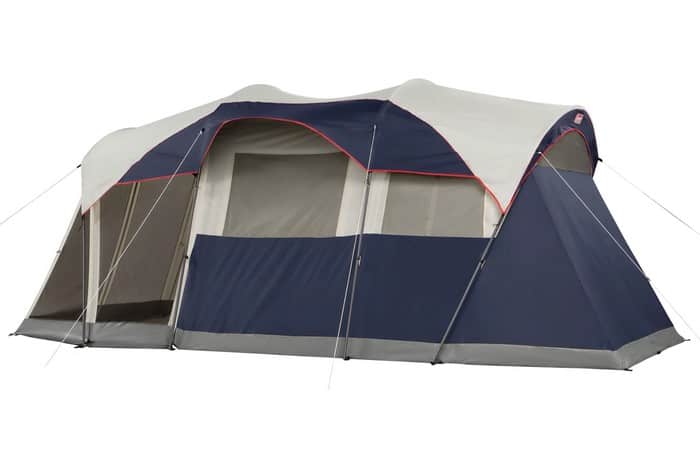
7. Coleman WeatherMaster 6-Person Tent With Screen Room

Tent Size: 6 person | Seasons: 4-season | Weight: 34.14 lbs | Inside Height: 6 ft 8 in | Floor: 11 x 9 ft & Screen Room 9 x 6 ft | Setup Time: 20 mins

With the Coleman WeatherMaster 6-Person Tent with Screen Room, you can unwind while watching nature change before your eyes. This outdoor tent, which is excellent for car camping and long camping vacations, contains a separate floorless screened chamber that provides additional ventilation on warm days, safe storage, and a bug-free dining area. In order to keep you dry, this camping tent is built with the WeatherTec system, which contains unique welded flooring, inverted seams, and a rainfly for added weather protection.

The tent has storage pockets to help you keep your belongings organized and has space for two queen-size airbeds. The curved windows increase air flow while keeping water out. An E-Port makes it simple to bring electrical power inside your tent, and a hinged door makes it simple to enter and exit the tent. This 6-person tent will withstand season after season thanks to its sturdy Polyguard fabric construction. Tent camping year round requires one of the best tents for camping.

A hinged door with a pending patent offers simple access and exit as well as a little bit of at-home convenience. There is enough room for the entire family in the Coleman WeatherMaster 6 tent, which features two rooms. The 17 by 9 (W x D) footprint and 6 ft. 10 in. center height make it easy for up to six campers to sleep inside. Easy access is provided by two doorways. A second floorless covered room offers additional cooling on hot days, a fantastic location for meals and gatherings, rain or shine, and secure storage.

Through the use of Variflow adjustable airflow, a vented Cool-Air privacy Port, a privacy vent window, and an all-mesh ceiling, Coleman’s Comfort System offers great ventilation control. An inside gear pocket makes it easy to keep things organized, and a handy electrical access connection makes it possible to connect a cord from your inside-the-tent item to an external power source. Two color-coded poles, continuous pole sleeves, shock-corded fiberglass poles, a distinctive pin-and-ring design, and InstaClip attachments make setup quick and easy. Simple instructions are stitched inside the carry bag’s handy pocket, and additional stake and pole bags are also provided.

The Coleman WeatherMaster 6-Person Tent can be set up in about 20 minutes, and it can be packed away safely in the expandable carry bag that comes with it. You can easily pack the bag by tearing away the rip strip.

PROS
Roomy tent with space to spread out
Brilliant mesh pockets for handy storage
Awesome screen room protects you from bugs
Well-made construction should last
Hinged doors are SUPER convenient

CONS
Setup could be a lot quicker
The tent stakes could be better
Might get chilly in cold weather

Enjoy bug-free lounging and extra ventilation in a separate screened-in room that also offers an additional sleeping area on warmer nights. For living outdoors full time, this is one of the best tents for camping.

living outdoors full time

8. Danchel Outdoor 8 Person Large Lightweight Yurt Tent

Tent Size: 8 person | Seasons: 3-season | Weight: 30 lbs | Inside Height: 10ft | Floor: 16 x 4 ft | Setup Time: 20 mins

Check out the Danchel Outdoor 8 Person Large Lightweight Yurt Tent if you’re looking for a simple entry point into the world of canvas tents. It is considerably lighter and less expensive than canvas while still providing the same remarkable breathability. Fabric made of 300D Oxford is used to achieve this. Given that Oxford is a form of cotton blend, it falls in the middle of synthetic and natural canvas. Well-Ventilated. No stove jack. A door that is 60″ tall, two large PVC transparent windows on top, and four ventilation windows with mesh on the wall. When camping, take in the breathtaking scenery.

You get a lot of tent for your money with floor measurements of 16.4′. In truth, a great deal of campers were astounded by its vastness. The 10′ ceiling height also makes the offer more appealing. The Danchel Outdoor doesn’t cut corners when it comes to performance, yet being far more cheap than its canvas relatives. It breathes, for example, just like a real canvas tent. The ventilation issues that might come with a synthetic option were not a problem for users. Campers living outdoors full time must have one of the best tents for camping.

PROS
Ventilation of canvas for a fraction of the weight
More affordable price tag
16.4’ is a good size that campers love
Can handle poor weather

CONS
The windows can’t be zipped from the inside

It doesn’t cut corners when it comes to performance, yet being far more cheap than its canvas relatives. Campers living outdoors full time must have one of the best tents for camping.

best tents for camping

9. Dome Camping Tent 5-6 Person

Tent Size: 5 person | Seasons: 4-season | Weight: 12.7 lbs | Inside Height: 6 ft | Floor: 12.5 ft diameter | Setup Time: 7 mins

Allow us to introduce the Dome Camping Tent 5-6 Person to you if the high price of some of these long-term tents has been frustrating you. This tent opens up the world of long-term tent living to those of us without a lot of extra money, unlike some of its more pricey cousins. You’re not purchasing a piece of crap, despite the price being reasonable.

One benefit of the 12.5′ diameter is that you have a respectable amount of space. However, there is not even close to adequate space for the 5–6 persons who were listed. Because of this, we suggest this tent for couples or singles, especially if you intend to stay in it longer than usual.

This Dome Camping Tent’s ability to be converted into a screen room is one feature we adore! That’s correct; except from the floor, the tent is entirely composed of mesh when the rainfly is removed. This should help you feel less constrained on the days when you’re getting a little bored of living in a tent. When you need to leave your tent walls while still being bug-free, just open the fly. One of the best tents for camping and living outdoors full time.

PROS
Much more affordable option
Transforms into a giant screen room
Comes with colorful flags and pennants to festoon your tent with your own flair

CONS
Not the hardiest option for bad weather
The steep taper makes it tough for multiple people to be fully standing simultaneously

This tent opens up the world of long-term tent living to those of us without a lot of extra money, unlike some of its more pricey cousins. For living outdoors full time, this is one of the best tents for camping.

living outdoors full time

10. Gazelle T4 Plus Extra Large 4 To 8 Person Portable Pop Up Outdoor Shelter

Tent Size: 4-8 person | Seasons: 4-season | Weight: 56 lbs | Inside Height: 78 in. | Floor: 168″ x 94″ | Setup Time: < 5 mins

If you’re sick of seeing these yurt-style tents with ridiculous, complicated setups, the Gazelle T4 Plus Extra Large 4 to 8 Person Portable Pop Up Outdoor Shelter is something to think about. You are, after all, here to camp, not to establish a base camp, correct? The pre-assembled hubs are responsible for the quick setup. The roof and corners only need to be popped out, according to this. Bam! immediate safety.

This has been dubbed the “Taj Mahal” of camping by some campers. Given the 7.8 x 14 ′ floor plan, they are probably not exaggerating. It makes a little more sense to compare this tent to a castle once the 6.5′ standing height is taken into account. Overall, users were quite happy with the build and praised its sturdy feel, which they claimed outperformed the department store’s low-cost rivalry. For living outdoors full time, this is one of the best tents for camping.

The Gazelle T4 has also had a few opportunities to demonstrate its abilities. It resisted all but the most corrosive blows while being buffeted by gusts of 40 mph. This tent can therefore take a lot of abuse, although it is not completely bombproof. Last but not least, this tent also includes a separate screen room. Even better, you can use a room divider to divide it off when you just need a little privacy from your long-term roommate(s).

PROS
Instant setup
Hardy construction withstands most of the poor weather
Lots of storage options; 2 gear lofts, storage wall nets and pockets
Bathtub floor protects against rain leaks
Screen room can be separated with a room divider

CONS
Can handle a lot of rough weather, but isn’t the best for extreme conditions


You May Want to Join Our Boondocking Group on Facebook For More Information

You May Want to Join Our Campfire Recipes Group on Facebook For More Information

June 25, 2022 0 comments
0 FacebookTwitterPinterestEmail
Dispersed Camping
All Travel Trailer

What is Dispersed Camping: 12 Good Tips to Get Started

by John - Laurel Rodgers June 3, 2022
written by John - Laurel Rodgers

Dispersed camping is a form of camping outside a designated campground with free motor vehicles to take away from mother nature. This can be done with just access to the outdoors or going to areas where camping is legal. Dispersed camping offers you more privacy and less noise as it’s not full of other people which equals a good time for you and others. Dispersed camping is essentially dispersed camping because it can be found wherever you want. This means that a person would likely stay at campsites and national parks that are not always near civilization but still have close access to water and fuel.


check out our video


Want more ideas to round-out your Boondocking and Camping Knowledge?
A lot of great ideas are in these posts!

  • 5 Top Boondocking vs Dispersed Camping Choices
  • 14 Top Must Know Boondocking Tips For Beginners
  • What is Dispersed Camping: 12 Good Tips to Get Started
  • 8 Tips to Free Boondocking and Free Camping
  • Boondocking Lifestyle – 10 Easy Beginner Tips
  • The Top 10 Boondocking Safety Tips

These areas would probably be somewhere in the wilderness and away from populated areas. The Bureau of Land Management is often used for this form of camping, as it’s not technically illegal. Many people choose to camp here, as it can give you a more isolated feeling. Dispersed camping can take place on public land or private land. The main difference between the two is that private land requires permission from the owner to use for camping.

However, private land won’t be set up with a campground or trash service. It will likely be kept as it is, meaning no benefits such as fire pits or toilets. In dispersion camping, you must make your shelter from natural resources. This can mean using trees, rocks, and whatever raw materials are available. You can also build a fire pit or make a fire ring to sit around the fire. The best way to disperse camping is to find a quiet area where the amount of people is low. You should also be wary of the weather conditions and ensure that the site you will be dispersed camping in isn’t prone to heavy rain or dangerous weather.

Although dispersed camping can be done at any time of year, it can be done best between May and October because it is when the weather is most pleasant for camping. One good thing about this is that you receive a lot of nature in your camping spot. You will likely be able to find a quiet place with little disturbance. This can be an excellent experience because you never know what you will see when you are out. There is a lot of diversity in the different types of dispersed camping. This means that there is a wide variety of places where someone can disperse camp. Dispersed camping can occur in any environment, including near water sources and mountains, near rivers, and even inside forests if you want to avoid people.

12 boondocking tips (1)

Can Anyone Do It?

Anyone can do dispersed camping, but people need to know their surroundings. If you are dispersed camping in a place close to a city and have too many people, you should try going on public land instead. This is because dispersed camping can be dangerous without planning, so it’s best to avoid crowded areas. If you plan to do dispersed camping for the first time, know where you are going. If possible, you should always stick to public land and never go alone.

Unlike camping in a campground, dispersed camping does not have any rules about staying in one place for long periods. You can stay in one place for as long as you’d like, but this does come with some risks. Try to stick to established campsites and spread out your stay. Dispersed camping is open to all ages, and it is also elementary, so it can be done by anyone who feels like it. Many areas do not require a permit. This means that you can be as private as you want without any access.

Just make sure that the place you are dispersed camping is legal, and you will be all set. If you plan on dispersed camping at a place that requires a permit, make sure you make the appropriate arrangements before your trip. The best way to disperse camp is to plan everything out before setting up your site. This means you need to know where you are going, how long you are staying, and what types of resources are available. The three best places for free camping are national forests, national monument area or of course BLM land. Both BLM and the U.S. forest service have millions of available lands.

If boondocking with a family you may want to look for sites that have pre- constructed fire rings, picnic areas with picnic tables, trash cans, reliable cell service in case of an are emergency and are more easily accessible.

Tips To Start Dispersed Camping

It is essential to have the right tips when carrying out dispersed camping. You want to make sure you are prepared for the campout you have planned. This includes having access to all necessary items but knowing how far you will be from home and how much distance it is. The following are some tips to help you out with dispersed camping:

1) Planning and Preparation

Ensure you have all of your camping gear and supplies before you leave. Dispersed camping is usually done on public land, but this does not mean that it is a public service. So make sure that you have everything that you need before setting off. It won’t be easy to get what you need when you arrive at your destination if you don’t. You want to make sure that your campsite is established before the weather turns for the worse or any other unexpected occurrences occur.

Search for that best place before you leave using resources like google maps, the internet, and look for any of these that may be close to home to get your start boondocking . Dirt roads with camping areas, free state parks, recreation areas, state forests, state forest land, wildlife management areas and national grasslands. All of these can be free resources and can be found closer to home.

2) Monitoring the Weather

It is essential to monitor the weather at all times. This means you need to know when there is the possibility of rain and what will happen during the storm. You will also want to see if it’s safe to travel or if you should stay put. This can occur in any weather condition, but if it happens at night when other people are dispersed camping, it can cause a problem. No one wants to be stuck in their car during a storm, but this is what you may find yourself doing if you don’t know the weather patterns of your campsite.

3) Conserve Your Resources

There are certain things that you need to make sure that you conserve while camping. This can include water, wood, and different food sources that aren’t as easy to obtain. It is important to conserve everything because dispersed camping doesn’t have any amenities nearby to support it. You cannot Camp Firewood at all times. Avoid having a massive fire to spread warmth, as this can cause forest fires and get you into trouble. So while dispersed camping, you should always try to conserve your resources and use them wisely.

Dispersed Camping

4) Safe Traveling

When traveling, you must know where the nearest help is. This can include if there is a hospital nearby or even a gas station in case of an emergency. You want to make sure that you travel safely and take every precaution possible. If you have a motor vehicle, use maps and GPS to ensure that you have the best route to get to your destination. You must make sure that you travel safely and always come prepared for anything.

5) Firmly Establish Your Camp

Try to stick somewhere safe from the weather and other people when establishing your camp. If you can find a place where you are hidden or away from most public activity, this is the best way to go. If possible, keep a fire extinguisher or something of the sort in case of an emergency. If you set up camp with the right supplies, you will be able to survive any weather. The more prepared you are, the better off things will be.

6) Stay Well Hydrated

When dispersed camping, it is essential that you stay hydrated. There are no amenities available to support your trip if you are not hydrated or find that water sources have been contaminated. You should make sure that you have enough water on hand for yourself and any visitors that may come along. Make sure you have enough food with you because there’s nothing worse than finding yourself in a survival situation.

7) Camp With a Partner

This is one of the best part when sharing a wilderness experience dispersed camping with a partner. If both of you are equipped with the right supplies and know-how to use them, you will stay safe throughout your trip. This will also allow you to spend more time enjoying your surroundings. You will have that protection from nature, which many people want when away from civilization. So make sure you camp with a partner whenever possible.

8) Leave No Trace

Dispersed camping can be a fun way to enjoy your surroundings, but it is also essential to take care of your campsite. The last thing you want to do is leave large amounts of trash and debris in your site as some dispersed campers do. If you are not disposing of your trash correctly, this could worsen things during a camping trip. To avoid problems, follow the Leave No Trace principles whenever possible.

If you do this, you will have no issues leaving the area better than when you found it. Human waste should be disposed of correctly as well. In some areas, like in national parks, you cannot use an outhouse because there can be a risk of poisonous snakes and other creatures living in your waste. So make sure to follow the correct procedures with this one.

Dispersed Camping
9) Be Wise With Your Fire
When camping, you want to make sure that you are using fire as a source of warmth and not as a way to set things on fire. Some places let you collect dead wood and others you must bring your own. Always be aware of burn bans in your area.

The last thing you want to do is get yourself in trouble by doing foolish things with fires. Make sure you use your fire as a source of warmth and get it out as soon as you are done. It is also essential to ensure that your fire is completely extinguished before you leave.

If you have a campfire, make sure the fire is put out before bedtime or leaving for the day. Do not build your campfire in a place with dry leaves or other combustible things near the fire. This could result in fires that can get out of control and spread throughout the forest. So make sure you follow this protocol when camping, and you will have no problems with any wildfire.

10) Protect Your Camping Area

Dispersed camping can be a fun way to enjoy your surroundings, but you must keep everything safe. When dispersed camping, it is essential to protect your personal property from being destroyed. This includes making sure there are no signs of trespassing on your property because many people may be passing through the area. You can also set up your camp in an area that is not easily accessible by other people. This way, no one else will disturb your campsite while away. This is the best way to ensure that you have the best time and don’t get into any situations that might be dangerous or put yourself in harm’s way.

11. Make Sure You and Your Campsite are Legal

This is very important when dispersed camping. Make sure you check with the local offices to ensure that you have permission to camp there. If possible, get a permit for your camping area to avoid getting into any trouble for being there. The last thing you want is to get into trouble for camping in the wrong area or doing something illegal. You must follow the rules and regulations so that your trip is safe and fun. If you do this, you will have a fantastic time dispersed camping and will not have to worry about any problems with being in the wrong place at the wrong time!

12. Do Your Research

If you are going to be dispersed camping, you need to find the best locations to go and make sure they are out of harm’s way. As with any camping trip, you must do your research before going. This means researching the area beforehand and figuring out how much time you’ll need there. Make sure that you know what time of year it is to get the best settings for your trip. It’s also essential to get the best gear for your trip so that you will not be uncomfortable in any way. Always be aware of of your exact location to avoid private property.

Dispersed Camping

13. Follow the Rules

To ensure that your dispersed camping trip is as safe as possible, you will have to follow all of the rules and regulations. Some places will have rules regarding how many days you can camp out in an area. Others may have regulations about fishing or any other activities that are allowed. Make sure you follow the rules for dispersed camping, if there are any, so that no one comes down on you unexpectedly.

14. Scout Out the Area

If you are going on a long trip and will be dispersed camping for a couple of days, you must scout out the area. This is so that you can better know where you’ll be sleeping and see where all your water sources are and how many other people will be camping around you. Don’t just park up in the middle of nowhere and hope you get lucky. This can be dangerous and cause you problems when you’re away from home. Make sure that you scout out an area before you go. You will want to check if there are no roads nearby because that could make it difficult for you to get out if something goes wrong. Forest service roads are another thing you will want to look out for. Look for an area with a water source nearby.

15. Carry the Right Gear

You must bring everything that you need when dispersed camping. Make sure you have all the gear with you when you go so that there is no chance of problems. This means putting the right shoes, clothes, and camping supplies in your car before going on your trip. If anything goes wrong, then at least your trip will be safe and enjoyable because you’re prepared for anything. Other things to consider are toilet paper, toilet facilities or a portable toilet.

Dispersed Camping
16. Be Cautious Choosing A Campsite

When dispersed camping, you can pick out a spot in the woods that has an area that you feel would be ideal for dispersed camping. You will want to check out the place before you go. This is so that you can see what kind of area it is and how safe it will be for your trip. The last thing you want is to get into bad weather conditions or other hazards when you’re away from home on your trip. You can tell if the area is safe for dispersed camping by looking at the trees in the area. If there are many large trees around, you will know it will be challenging to set up your camp.

17. Beware of Wildlife and Wild Fires

The last thing you want is to get into trouble when dispersed camping. Ensure you do not get too close to any natural hazards such as wildfires or wildlife. You will also want to make sure that you take note of the area so that you are not camping in a place where natural hazards should be avoided. Debris, spots that animals or fires have damaged, and areas with many roots are all examples of places where natural hazards can occur. Know the wildlife you may encounter and bring a bear canister when camping in bear country.

Conclusion

Dispersed camping is a great way to enjoy the outdoors no matter what season it is. You will have a great time if you go dispersed camping, so make sure that you take all of the precautions necessary to ensure your safety and enjoy your trip. Just be sure you are prepared for any natural hazards and that you are getting everything to help you enjoy your trip. While this is a great opportunity one should always be well prepared for any emergencies.


You May Want to Join Our Boondocking Group on Facebook For More Information

You May Want to Join Our Campfire Recipes Group on Facebook For More Information

Check Out Our Pictures On Instagram – Our Big Escape.

June 3, 2022 0 comments
0 FacebookTwitterPinterestEmail
Power Inverter Jackery
All Travel Trailer

The 5 Best Power Inverters for Boondocking and Dispersed Camping

by John - Laurel Rodgers June 2, 2022
written by John - Laurel Rodgers

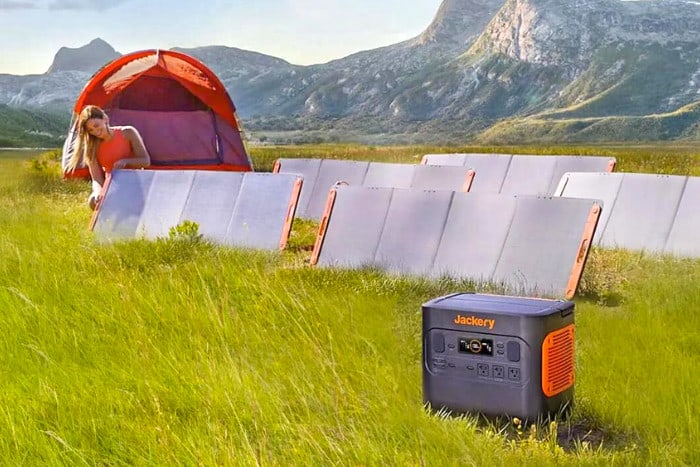
Power inverters are devices that help to transform energy from solar or Direct Current DC to Alternating Current AC. The best such inverters for boondocking are of diverse categories and provide energy for some appliances. How much power they supply you will depend on their storage capacity. Recently, automobiles have in-built USB ports that support the charging of phones and laptops. Typically, inverters are measured in Watts, and the larger the wattage, the higher the probability of powering several devices for long. Inverters are a great alternative that helps boondocking enthusiasts maintain a reliable power supply. The generator is a step up from the inverter and is a reliable power source.


check out our video


Want more ideas to round-out or upgrade your Gear?
A lot of great ideas are in these posts!

  • 5 Big Rooftop Tent Camping Challenges
  • 20 Great Boondocking Travel Trailer Accessories
  • Best Family Kayak 8 Important Tips For Buying One
  • The Top 5 Power Inverters for Boondocking and Dispersed Camping
  • 8 Tips To Buy the Best Pop Up Canopy Tent

However, their weight and operational parameters are not ideal power sources for boondocking purposes. Power inverts come in sizes including 1000, 3000, and 5000 Watts. The 3000 Watt is perfect because it is neither too heavy-duty nor too low-powered. Power inverters for boondocking come in different designs according to the manufacturing company. For example, not all inverters incorporate USB outlets, solar panels, LED displays, etcetera. Selecting a suitable power inverter for boondocking can be quite challenging. This article will provide comprehensive information on the top five power inverts for boondocking and dry camping.

Best Power Inverters

The Most Important Features When Choosing Your Power Inverter

Power inverters function like automobiles and possess various features that distinguish them. Before purchasing a power inverter for boondocking, it is imperative to scrutinize the following features that will enable you to ascertain the specific type of inverter you need. To achieve the best power inverter status it had to have a great cooling fan, no short circuits, LCD screen with a good LCD display of the battery level time left until your next charge. Other considerations are the number of power outlets, enough power to run your pre-determined list of electronic devices and low wattage kitchen items. Very few will run microwave ovens, a power drill, most small appliances and if they will the drain on your total time will be so significant you will not want to waste that much energy.

What they will do is run a small coffee maker, charge a digital camera, mobile phones computers and anything more is best left to times you have shore power.

Electrical Load Rating

A good power inverter should have a good electrical load rating to support several operations. A power inverter for boondocking with a low load rating than the required electrical load to help is likely to break down while at work. When the load necessary is particularly large, it is important to reinforce it with a good custom inverter.

Application for the Equipment

The primary factor to consider is the specific application for the equipment. For instance, if you require inverters for transforming solar energy into Alternating Current (AC), you would prefer a solar inverter. Similarly, if you need an inverter to connect to the power system, you would select the grid-tie inverter. Thus, the special equipment’s application is a crucial factor to consider.

The Operating Environment

The particular operating environment has a significant influence on the ideal power inverter. Aspects like product certifications and construction-grade also play a huge role. For instance, if a power inverter will be utilized in an industrial setting and wear out due to damaging operations, the best type to consider is the industrial-grade power inverter.

Technical Customer Support

There are power inverters for boondocking that might be difficult to operate. Moreover, the process of installation, implementation, and maintenance of power inverters can be challenging. An inverter dealer who provides convenient technical customer support will enhance efficiency and saves time.

Certification

Certification will provide a guarantee of the authenticity of a power inverter. It is vital to select a power inverter for boondocking with the correct level of certification following the specific inverter’s application and environment. This will prevent inconvenience while purchasing the ideal power inverter for your needs.

Which  Power Inverters Have the Best Solar Panel Charging

Choosing the best inverter for boondocking is pretty much determined by two things. First what is the total run time stored in the battery bank and second will have to charge it on a daily basis. You should really look for an inverter that will provide storage to run your camp fridge for a minimum of two days. The Jackery 2000 is the only one we tried that would meet that need.

Here are some others we tried and the results from each. The Jackery with its compact design, extra power it can store, great features is the portable power inverter for us.

WZRELB DC to AC Pure Sine Wave Inverter

WZRELB DC to AC Pure Sine Wave Inverter

This is an off-grid solar inverter that has excellent solar panel charging. It can be attached with a 12 Volts battery. The specific input voltage is 12 Volts DC while the output voltage s 120 Volts AC. The particular wattage for this inverter is 2500 Watts at a constant usage and 5000 Watts at peak usage. The inverter’s efficiency is between 85% to 90% and can supply power to at least five panels thus, and it’s a great choice for RVs and homes.

Jackery Solar Generator 2000 Pro

Jackery-Explorer-2000 Power Inverters

This inverter’s charging time is 2 hours using an AC wall outlet or 2.5 hours via 6SolarSaga 200W solar panels. The inverter is an excellent device that supports pass-through charging and quiet seamless charging. Its approximate wattage capacity is 2160 Wh, 2200W AC power output, and 4400 W at peak performance. The device’s battery power between charges is approximately 4 hours and can support several solar panels, thus making it an ideal power inverter for boondocking.

NECESPOW Portable Power Station

NECESPOW Portable Power Station Power Inverter

This solar inverter has a remarkable battery life, making it an ideal power source for boondocking. It comprises a Lifepo4 Battery that offers approximately 2000 cycles and has at least ten years. The average charging hours for this inverter are 6 – 7 hours. However, the power inverter for boondocking can charge within 2 – 3 hours using a wall-mounted type-C charger. It can operate for 8 – 10 hours and supply power to at least four solar panels. The specific wattage for the inverter is 150 Watts and 300 Watts for peak performance.

Which Type of Inverter is Best for Boondocking?

Pure Sine Wave Inverter

A sine wave inverter works to transform power from a battery from Direct Current DC to Alternating Current AC. The converted energy can then be utilized to distribute high-quality electrical current to various home apparatus. There are two types of sine inverters: modified sine wave inverters and pure sine wave inverters. A pure sine wave inverter is quite expensive because it generates AC power similar to an ideal sine wave. A pure sine wave is stable, reliable, and consistent and offers reliable and regular operations.

Pure sine wave inverters are effectively functional because they can support any equipment built to work with pure sine wave energy. There is special equipment strictly mandated to be used by pure sine wave power inverters for boondocking. It will get damaged if used with other types of sine wave inverters. Some of the devices that necessitate pure sine wave inverters include satellite systems, microwaves, audio and video equipment, refrigerators, battery chargers, various medical equipment, etcetera.

Some of the benefits of pure sine wave inverters include preventing crashes in computers, reducing electrical noise in the home and office appliances, preventing glitches in computer monitors, and having a harmonious and clean power output ideal for expensive devices. The primary con of pure sine wave power inverters for boondocking is the cost, whereby the pure sine wave inverter is, on average, $90 more costly than a sine wave inverter.

Car Power Inverter

A car power inverter is a machine that transforms a car’s battery power into Alternating Current AC that can be used to run typical home electronics and appliances. A car power inverter for boondocking with the ideal wattage can help you power the necessary appliances and devices for convenient boondocking. Car power inverters can run blenders, refrigerators, microwaves, laptops, coffee makers, power tools, cooking equipment, etcetera.

There are several benefits of car power inverters. A car power inverter is convenient for charging phones or laptops in the automobile. These inverters also enhance entertainment because they support laptops, DVD players, CD players, gaming consoles, etcetera. Car power inverters are convenient because they provide a reliable and affordable power source. Some of the common disadvantages of car power inverters for boondocking are that they might easily drain your vehicle’s battery. Some are quite expensive and are likely to get damaged due to burn-up.

Our Top 5 Inverter List

1. Jackery Solar Generator 2000 Pro ( THE BEST)

Jackery-Explorer-2000 Power Inverters

The Jackery Solar Generator 2000 Pro has a power capacity of 2160 watt hours, whereby the typical output power is 2200 Watts AC and 4400 Watts at peak performance. The power inverter for boondocking can be charged with six Solar Saga 200 Watts solar panels within 2.5 hours. In contrast, an AC wall power source can charge the inverter within 2 hours. Furthermore, the device can be recharged with the aid of a carport. A full recharge can operate for approximately 48 hours. The Jackery Solar Generator 2000 Pro incorporates a high-quality lithium battery. The battery consists of four temperature core detectors that enhance efficient charging and two chips that reinforce dual battery protection.

The power inverter for boondocking is eco-friendly, seamless, efficient, and supports pass-through charging. The device is portable, user-friendly, safe, and can support eight devices. Examples of appliances that can be supported by the Jackery Solar Generator 2000 Pro include blenders (5 hours), coffee makers (3 hours), projectors (15 hours), refrigerator (3.3 hours), microwave (96 minutes), hand drill (60 hours), air conditioner (2 hours), mini cooler (15 hours), hot plate (48 minutes), electric grill (1.1 hours), etcetera. The device consists of three USB ports and four AC outlets. It can be remotely controlled and has an LCD for easy user control. The Jackery Solar Generator 2000 Pro price is $3599.00 and is accompanied by a 5-year warranty.

2. BLUETTI AC200MAX Expandable Power Station (Distant 5th)

BLUETTI AC200MAX Expandable Power Station Power Inverter

The BLUETTI AC200MAX Expandable Power Station is a great pure sine wave power inverter for boondocking with seven different charging methods: solar, generator, car, lead battery, AC + solar, Dual AC, and AC, respectively. The power inverter has a capacity of 2048 Wh and can be controlled remotely or via an online application. The respective charging time of the inverter is determined by the charging method. The AC adapter is the fastest with 5.5 – 6 hours, while the car outlet is the slowest with 10 – 20 hours. The respective wattage of the power inverter is 2200 Watts AC and a peak performance of 4800 Watts. The battery life is quite convenient at 3500 plus life cycles of 80 %. It has two USB A 18W ports and two USB A 5V3A ports. There is a cigarette port and four AC outlets. The power inverter for boondocking has an LCD that is user-friendly and can be used to power appliances such as refrigerators (10 hours), air conditioners (1 – 4 hours), coffee makers (1.5 hours), electric grills (1.5 hours), CPAP (30 – 40 hours), and light (150 + hours). The average price of the BLUETTI AC200MAX Expandable Power Station is $1899.00 and is accompanied by a 24-month warranty.

3. Powkey 200-Watt Portable Power Bank

(Best Of the Rest)

Powkey 200-Watt Portable Power Bank

This is a portable and multifunctional pure sine wave power inverter for boondocking. It is of better performance than the modified sine wave inverter and can be used with diverse equipment. This is because it reduces noise in electronic appliances, is an eco-friendly energy source, and prevents computer crashes. The power inverter consists of four USB ports and one DC port. The number of AC outlets is four, and the inverter has an average capacity of 146Wh and is an ideal inverter for boondocking. The average wattage for the inverter is 200 Watts and can power televisions, coffee makers, lamps, toast makers, laptops, printers, phones, fans, car pumps, mini-refrigerators, etcetera. The special charging power is utmost of 200 Watts, and the time between recharging is determined by the power consumption of the respective devices. The power inverter requires approximately 6 – 7 hours to fully charge and consists of four in-built LED indicators for convenient monitoring. This power inverter for boondocking has an excellent battery circle life of 1000 times 80% plus. The average price for the 200-Watt Portable Power Bank is $149.99, and it is a convenient and affordable power source.

4. NECESPOW Portable Power Station (Best Of the Rest)

NECESPOW Portable Power Station Power Inverter

The NECESPOW Portable Power Station comprises Lifepo4 lithium batteries that are safe and eco-friendly. The batteries have a 2000 times life circle or at least ten years. There are five methods of charging the power inverter for boondocking. They include a car charger, AC wall socket, PD charger, solar, PD charge, and AC outlet. The average charging time is 6 – 7 hours, and the capacity is 161Wh. In addition, the inverter’s respective wattage is 150 Watts and 300 Watts, a peak performance. It comprises an adjustable LED display that enhances easy monitoring. The power supply for the inverter includes one AC output, two DC outputs, two USB outputs, and one QC3.0 output, and the total AC outlet is six ports. The particular benefits include its portability, user-friendly, and seamless. They can be used to charge multiple devices simultaneously and have a great safety feature that ensures the battery does not explode or burn due to excess power. The NECESPOW Portable Power Station is good for power tablets, fans, laptops, lights, cameras, CPAP machines, drones, cellphones, in-car appliances, etc. The power inverter for boondocking is ideal for camping, RVs, Van tours, fishing, drone, and off-grid battery backup. It has an LCD that enhances user-friendly features significantly. The average price for the power inverter is $139.88, and it comes with a 1-year warranty.

5. Goal Zero Yeti 1500X Portable Power Station (Really Close Second)

Goal Zero Yeti 1500X Portable Power Station

The Goal Zero Yeti 1500X is a portable and reliable power inverter that contains a lithium-ion battery. It is a safe, reliable, and portable inverter ideal for workshops, power outages, camping, boondocking, tailgating, etcetera. The average wattage of the device is 1500 Watts and 2000 Watts at peak performance. The device is user-friendly and can power up to seven devices. There are three methods of charging the power inverter for boondocking, including car charging, 600-Watt AC socket (3 hours), 230-Watt AC socket (7 hours), and 120-Watt AC socket (14 hours). Remote and special features can control it to optimize performance and enhance your experience.

The device has several USB-A ports, two 120V AC ports, and a fast-charging 60-Watts USB-C power outlet. The Goal Zero Yeti inverter can power various equipment, including refrigerators (28 hours), lights (138 hours), medical devices, tablets and phones, internet devices, laptops, blenders, televisions (15 hours), CPAP (24 hours), grills (26 hours), speakers, power tools, fans, drills, drones, cameras, and GPS devices. It has an LED display that enhances monitoring and settings. Due to its portability, the inverter can be used as an alternative power source in home and office settings. The Goal Zero inverter is also an ideal power inverter for boondocking, camping, etcetera. The average price of the Goal Zero inverter is $1999.95 and is accompanied by a 2-year warranty.

Conclusion

According to the manufacturing company, power inverters for boondocking come in different sizes and designs. The size is influenced by the specific Watts required to operate the respective devices or appliances. For instance, if you need to power a 24-inch television, speakers, and some lights, you will require a power invert that supplies at least 430 Watts. The type of devices that are being powered influence the particular kind of invert to use. For example, if the devices being used require a lot of power, a more powerful inverter is needed. However, boondocking does not necessarily necessitate the use of heavily powered devices.

The common power inverters for boondocking are light, coffee making, cooking, grilling, and charging. This does not generally necessitate a very powerful power invert. A good power invert is important because it will guarantee reliability and efficiency, thus preventing unnecessary emergencies while boondocking. Ensuring that the power inverter of choice has great safety measures is imperative. For instance, the installation must be simple, and the inverter should incorporate formidable safety features that will protect you from unmentionable harm. This article provides all the necessary information relating to power inverters for boondocking and dry camping.


You May Want to Join Our Boondocking Group on Facebook For More Information

You May Want to Join Our Campfire Recipes Group on Facebook For More Information

Check Out Our Pictures On Instagram – Our Big Escape.

June 2, 2022 0 comments
0 FacebookTwitterPinterestEmail
Off Grid Traveling
Boondocking

10 Best Off Grid Travel Tips For Boodocking Beginners

by John - Laurel Rodgers June 2, 2022
written by John - Laurel Rodgers

Are you an adventurous type of person? Would you love to explore the great outdoors on an off grid travel vacation but your not sure where to start? If you answered yes to either of these questions then I just Know you’ll love to learn more about off grid traveling to your remote location. My family goes off grid traveling and camping as often as possible! Remember that you can camp off grid if you find a spot you want to explore more as you are traveling.

Bring all of your gear along to ensure that you can stay a while if you find that perfect spot. Its a great way to get away from the stress and traffic of everyday life. So lets talk about the most important things you will need for a safe and enjoyable vacation. Don’t get it wrong and just leap before you look, off grid life can be a lot of hard work.


check out our video


Want more ideas to round-out your Road Trips?
A lot of great ideas are in these posts!

  • Our Top 10 Family Road Trips
  • 13 Easy Off Grid Vacation Tips
  • 6 Great Top Off Grid Travel Locations
  • The 10 Best Off-Road Adventures

Off Grid Travel

What Is Off Grid Travel?

Off grid adventures can be best explained as going and driving out on the back roads. Maybe even as taking back roads off the back roads. Driving out on paths or even making your own paths. Off grid traveling is essentially traveling into the woods, through the woods, and going just as far as you can go.

Most people who enjoy traveling off grid have durable utility vehicles or ATV’s. These types of vehicles can go places regulars cars and trucks just cannot. Off grid travel really ranges from a hammock, a tent, motorhome or camping trailer. There is not one type of boondocking.

Your Vehicle Type Matters

If you really want to know everything about off grid traveling as well as off grid living that’s the first thing you should probably know. Your vehicle matters. Don’t go out in the mud and get stuck with a little truck or worse yet a car. It’s just not a good idea. If you want to go out and really explore the unknown make sure that your vehicle is equipped and able to do so. Most people who do this as their lifestyle do combine a small travel trailer with a good 4WD vehicle to get into the more remote areas.

8 boondocking tips

Bring A Charged Phone and First Aid Kit

Another thing you need to know about off grid travel is that it’s really important to have a charged cell phone when you travel anyplace off grid. What if you do get stuck and you can’t get un-stuck? There won’t be anyone near by to help you. You will have to have a way to call for help or else you’re going to be stranded. It’s a really good idea to have a GPS device of some sort as well. It’s easy to get lost in the woods.

A good first aid kit is essential  for the out of doors. Nicks, scrapes, and small wounds require you give them the attention they need to avoid infections. It may be several day before you find anywhere to get these supplies.

We use solar panels but have one phone turned off to preserve the battery for emergency use if the others are used up and the solar is not charging due to clouds. If this is a lifestyle you enjoy then you may want to invest in a Jackery Solar Inverter. They are the best solar system that you will find and will give you as much power as your will need.

They are equipped with as big a battery bank as you will need. We are not fans of a portable generator and most boondockers do not want to be around them. These are the perfect way to keep all of your electronic devices and more charged. They will not run air conditioners but will provide enough of a power source to help with coffee in the morning and keep other smaller appliances available.

 Use a GPS

That leads us to another thing you need to know about off grid travel to have a great camping trip. You can, and possible might, get lost if you don’t have at least a compass of course GPS is the best way but a compass never hurts. At very least. Roads tend to wind and curve. They go up, they go down. It’s so easy to lose your sense of direction in the woods, even on paths, and it’s common for people to get lost when roads and paths are unmarked.

Especially when there are crossroads and such. Sometimes you just don’t know which way to turn or what road to take to find your way back to where you started. GPS systems work all over the place. If you have a GPS when you are out venturing you’ll have little worry of getting lost. This is one of the MOST important things to know about traveling off grid.

Off Grid Travel Is Rough On Vehicles

The next most important thing to know about traveling off grid is that it’s really going to be rough on your vehicles tires. One time when my family and I went off grid traveling we blew a tire and didn’t have a spare. We had to call for help and have someone bring us the spare tire from our garage and all of the tools we needed to fix it. What a mess.

If we would have had the spare tire and tools with us we would have been able to fix it ourselves but instead our trip was ruined that day because we didn’t [plan ahead. Now I always tell people to make sure they bring along a spare tire just in case. Bring the tools to fix it too. That made me think too though that not just tires can have problems. Plan ahead for any potential vehicle breakdowns by bringing along a toolbox containing all of your most used mechanical tools and supplies, a jug antifreeze just incase you overheat or leak it, and oil.

Never run your vehicle if the oil is low and be sure to check it before you leave. If you notice a drip while you are out traveling you’ll be able to check it again and if it’s low you’ll have that extra quart or two with you because you thought ahead. Off grid traveling can be quite rough on your vehicle. Be prepared to stay safe.

Off Grid Travel

Fill Up On Gas and Bring Along food an plenty of Water

The next thing you need to know about off grid traveling is there’s no gas stations out there in the woods. The most critical thing is to bring at least twice as much water as you think you will need. A problem and you vehicle breaks down you will need those extra days worth of water usage. You will rarely find a water source for potable water.

There rarely grocery store, gas or towns off the less beaten path, no snacks or soda’s either. Make sure that you gas tank is full and that you keep good track of your gas gauge. Save yourself some gas to get back to civilization safely. Be sure to pack all of your own food, meals and drinks for the kids, and for you and your spouse as well. Dehydrated foods like fruits and nuts are a great option.

A cooler is a great idea. Stock it up with water, soda, juice what have you. It’s best to leave the alcohol all at home. I would never recommended drinking and off grid travel as it could and would be very very dangerous.

Dress In Layers

Another thing you need to know about off grid travel is that at different times of the day it will be cooler or warmer. In order to keep your family comfortable through the morning, day, and evening dress in layers. Bring sweatshirts or jackets too in case you get really chilly. It’s better to not be too cold, or too hot when you travel.

Being uncomfortable takes the fun out of it so dress accordingly to the weather, and in layers to prevent this from happening. If you plan on staying out all day and half the night you’ll be sure to thank yourself for thinking of this.

Let Someone Know Where You Are Going and When You Will Be Back

There are SO many things to know about off grid traveling and free camping ! Here is yet another thing. This next one is to know to always let someone else know that you will be out traveling off grid. Tell them the area you will be traveling and let them know approximately what time you’ll be home. Off grid driving is not like driving on a nice, smooth, paved road.

It can be rough, even dangerous if you don’t know what you are doing. Leaving this information behind with someone ensures that someone will come looking for you in the event that you don’t come home on time. Someone will know it’s not right and will come save you from being stuck, broke down, hurt, or what have you. It’s another one of those things that’s just a good idea.

Leave The Little Kids At Home

Although off grid traveling can be considered fun for the whole family I’m going to have to say that it’s just not a good idea to bring along little ones. Most of the time you will be using BLM land and it is not child friendly. There are cactus, snakes, spiders and more. Young, small children actually should not go off grid traveling. They get jarred around, it’s just too dangerous on so many levels.

My advice is to leave the little ones with the grandparents when you off grid travel. Go and have some fun alone as adults and let the kids be home same and sound. It’s safer this way. It’s easier this way. It also makes it alot more fun for the grown ups. Now older kids, such as teenagers, are fun to bring along! They have a blast and it’s a bonding family activity that they’ll want to do someday with their own kids.

Hey Dads…why not treat your wife to a day at the spa and go off grid traveling with your son? Maybe do a little off grid camping? Have some one on one quality hunting and fishing time?

Off Grid Travel

Bring A Camera!

If you really want to know everything you need to know about off grid travel then you just have to know that it is an experience you will never forget! Be sure to bring a camera because you will see all sorts of wild life. Look into the woods to see birds, flowers, different plants and trees, deer, fox, even a bear or two!

Take your time while driving and go slow enough to be able to observe and take in your surroundings. There no fun in a rushed trip. Plan your off grid traveling on a day when you have nothing else to do.

Off Grid Traveling Can Be So Bonding…

Another thing you need to know about off grid traveling is that it’s addictive. It’s such a rush and such an exhilarating experience that you will just want to go again and again and again. My husband and I leave the kids with their Aunt and go every weekend, weather permitting. The kids and my sister love the quality time together and my husband and I get some quality time of our own doing something together that we both really love to do.

I think it strengthens our marriage. It also makes us more patient parents because we get that time a way, that little break we need to relax and re-charge. It’s wonderful!

Mind The Local Weather Forecast

That leads us to the next thing you need to know about off grid travel which is the weather. It’s definitely a good idea to check the weather forecast for the area you will be traveling in before you go. It’s never fun to have it start raining, or to get really cold. No. Plan according to the weather for off grid traveling and make sure you choose a day that’s going to be dry, safe, and warm. It makes road conditions so much better, and it makes you way more comfortable.

Don’t be A Litter Bug and Make Sure Your Fire Is Fully Out

Off grid travel is so much fun that another thing you need to know about off grid travel is that sometimes as you’re driving along you’ll find a place you want to stay for a while. A place that just begs for a camp fire. Maybe you’ll find that place near a creek or pond that you see could be fished in. Maybe you’ll find it next to where a big buck is standing, you never know. It could just be somewhere that the view is lovely. A place where you’ve found peace.

For some off grid travelers these are the moments where they wish they would have brought their camping gear. Plan ahead for these moments. Bring your tent, gear and supplies along so that if you find that perfect spot where you want to build that roaring fire you can.

That leads us to another thing you need to know about off grid traveling. If you build a fire when you stop to rest or camp, be sure it is fully extinguished before you leave. Please, never leave your garbage behind either. It’s not good for the environment or wild life.

Off Grid Travel Adventures Are Becoming Increasingly Popular!

We have covered many things you need to know about off grid travel. You wouldn’t think there would be anything else but there is. Off grid traveling is pretty much now like a sport. It has soared in popularity over recent year and you would not believe how many people enjoy it! It’s amazing.

ATV Vehicles Vs. Utility Off Road Trucks and Jeeps

If we really want to talk about everything you need to know about off grid travel I will add that an ATV off grid travel experience is much different than a utility vehicle or Jeep type of off grid travel experience. How? You may ask. Well, ATV’s can go places that even off road utility vehicles can not. These types of vehicles require some sort of road or path to travel on. An ATV really does not. You can drive an ATV where there is no path, making your own. My husband and I used to do this all the time.

It’s so much fun. Some of the best memories that I have with my husband from our younger days are from when we were riding ATV”s through the woods. Off grid traveling. Exploring the unknown. We never knew quite where we’d go or where we would end up and that was part of the fun. If we got lost we always had a GPS so we could safely make it back home to the kids. It was so bonding and I will forever cherish those memories made with my love traveling off grid.

Off Grid Traveling

Take Your Time and Drive Safely

Off grid camping is not for people who are un-familiar with driving on back roads. If you are going off grid traveling for the first time you need to know that the most important thing to know about off grid traveling is to drive SAFELY. Do not be reckless or foolish. Take your time to be safe, and also to enjoy the surrounding scenery. Don’t try to do dangerous tricks or stunts to be cool or have fun. You’ll only likely get hurt or break your vehicle. Stay on a path with vehicles and do not attempt to drive into areas that are muddy. You might get stuck.

Enjoy Your Off Grid Travel Adventures

Just about everything you need to know about off grid travel has been covered in this article. I hope that you enjoy your travels as much as my family and I do. Remember to take lots of pictures! You might likely never see some of those birds or flowers again. That is unless you go traveling to the same spot again. I have found that my husband and I like the areas and certain routes we off grid travel on so much that we regularly use the same ones. You may find that to be true for yourself as well.

It’s nice to off grid travel in an area that you know. It is safer and reduces the risk of you getting lost. Choosing a location close to your home is best so that way you can go as often as you’d like to, there a place where you anywhere in the United States. Remember to always check the weather so you don’t get stuck out there in the wilderness in the rain nor cold. It’s a good idea to bring waterproof gear just incase if you will being going pretty far out on an ATV.

You don’t want to get soaked trying to get back to base. Have a flashlight with you if you are going out riding near dark just in case you break down or what have you. If you don’t don’t bring it, you’ll need it. Thanks for reading and take care!

You Definitely Need To Try Off Grid Traveling

Off grid traveling is definitely something you need to try if you love taken the less beaten path. Be sure to bring along a camera, tools, emergency supplies, a first aid kit, and a GPS. Remember to make sure your gas tank is full and that there are no gas stations for snacks and drinks either. Let someone know where you’ll be going and when you’ll be back just in case you have a situation or problem.


For complete photos and videos of our trip visit our photos on our page Instagram Page

You May Want to Join Our Boondocking Facebook Group Boondocking Group on Facebook For More Information

You May Want to Join Our Campfires Recipes Group Campfire Recipes Group on Facebook

June 2, 2022 0 comments
0 FacebookTwitterPinterestEmail
Pop Up Canopy Tent for Tailgaiting
All Travel Trailer

8 Tips To Buy the Best Pop Up Canopy Tent

by John - Laurel Rodgers May 28, 2022
written by John - Laurel Rodgers

Pop up canopy tents are perfect for multiple outdoor events. They are a must-have for camping, beach visits, tailgating, & backyard gatherings, to name a few. They provide much-needed shade from the sun and can act as a barrier from wind and rain. But with so many different types and models of pop up canopy tents on the market, it can be hard to know which one is right for you. This article will help break down the eight tips for buying the best pop up canopy tent.


Want more ideas to round-out or upgrade your Gear?
A lot of great ideas are in these posts!

  • 5 Big Rooftop Tent Camping Challenges
  • 20 Great Boondocking Travel Trailer Accessories
  • Best Family Kayak 8 Important Tips For Buying One
  • The Top 5 Power Inverters for Boondocking and Dispersed Camping
  • 8 Tips To Buy the Best Pop Up Canopy Tent

Best Popup Tents


check out our video


1. Best Canopy Tent Requirements

To get the best pop up canopy tent, you need to ensure that it meets specific requirements. We will look at what those requirements are so that you can make an informed decision when purchasing your next canopy tent.

The Frame: A pop up canopy tent mostly has an aluminum frame. However, some have a steel frame. If you are looking for a durable tent, you need to make sure that it has a heavy-duty frame. A sturdy alloy steel frame is the best option because it is durable and lightweight.

The Material: The material of the canopy tent is also important. You want to make sure that the tent is made from a durable material that can withstand the elements.

The Height: Another essential factor to consider is the height of the canopy tent. You want to ensure that the tent is tall enough to provide adequate headroom.

The Side Walls: Most canopy tents have sidewalls. These are great for providing additional sun and wind protection. They can also be used to add privacy to your campsite.

The Legs: The legs of the pop up canopy tent you choose are also essential to consider. There are two different types of legs: slant and straight. Slant legs provide more stability in windy conditions. Straight legs are better for use on hard surfaces.

The Price: The canopy tent price is also an important consideration. You want to make sure that you get the best value for your money. That way, you can be sure that you are getting a quality product.

2. Easiest Tents to Pop Up

Pop up tents are one of the most popular tents on the market. They are easy to set up, and take down and come in various sizes and colors. The most accessible tents to pop up are the ones with an E-Z UP system.

They have aluminum frames: These types of tents come with a frame that is easy to assemble, and they come with a variety of height options. Aluminum is the best because it is both lightweight and durable.

You don’t have to put the tent together: All you have to do is take it out of the bag, and it will automatically pop up.

They have a roller bag, making it easy to transport and store the tent. A roller bag also helps to keep the tent clean and dry.

They are easy to use: The E-Z UP system is easy to use, and it can be set up in minutes, making its ease of use one of the best features.

Easier Setup: With an E-Z UP system on your pop up canopy tent, you don’t have to worry about putting the tent together. You have to take it out of the bag, and it will automatically pop up.

Pop Up Canopy Tent for Backyard Picnics

3. Supplies You Need for Outdoor Events

When planning an outdoor event, you’ll need to ensure that you have all the necessary supplies.

A pop up canopy: A pop up canopy is a great way to provide shade and protection from the sun and elements for your guests. There will ensure your guests stay cool and comfortable during the event. You should also consider the square feet of shade and the height when choosing a pop up canopy tent.

A picnic table: A picnic table is a must-have for any outdoor event. It provides a place for guests to sit and enjoy the food and drinks. Choosing a picnic table with a built-in cooler will keep your food and drinks cool and fresh.

Sporting gear: If you’re planning on hosting sporting events, you’ll need to ensure you have all the necessary equipment. This includes things like balls, nets, and other gear for the specific sport.

4. Pop Up Canopy Tent For Best UV Protection

UV rays are harmful to the skin and can cause sunburns, so it’s essential to have a pop up canopy tent to provide UV protection. There are many types of pop up canopy tent choices that offer different levels of sun protection, so it’s essential to choose the right one for your needs. Sunny days can be enjoyable, but they can also be dangerous if you’re not adequately protected from the sun’s rays.


5. Using Your Pop Up Tent In Strong Winds and Heavy Rain

When setting up your pop up tent in high winds or heavy rain, use extra caution. Ensure that all the guylines are appropriately staked and that the tent is securely fastened to the ground.

Heavy Rains: In heavy rain, you may want to use extra tarps or plastic sheeting to help keep the inside of the tent dry. The rain fly should be appropriately taut and extend to the ground.

Rainy Days: You can probably get away with just using the rain fly if you’re expecting light rain. However, if there’s a chance of heavier downpours, you may also want to use a tarp or plastic sheeting.

Windy Conditions: In high winds, it’s essential to ensure that the tent is correctly fastened to the ground. You’ll also want to make sure that all the guylines are properly staked.

High Winds: When setting up in high winds, it’s essential to ensure that the tent is appropriately staked and that all the guylines are correctly secured. The rain fly should also help keep the tent from catching wind and blowing away.

Light Rain: The tent can be set up as usual in light rain. However, you may want to use a tarp or plastic sheeting to help keep the inside of the tent dry. It’s also good to have the rain fly properly taut and extend to the ground.

With a little bit of extra caution, you can use your pop up canopy tent in almost any weather condition. Just be sure to take the necessary precautions to keep yourself and your equipment safe.

Canopy Tent Provides Shade While Camping

6. Best Popup Canopy Tents For Camping Trips

Camping trips are one of the most popular reasons to use a pop up canopy tent. If you are planning a camping trip, choosing a spacious tent for all of your gear and supplies is crucial. You will also want to choose a tent made from durable materials that can withstand the elements. Below are the best pop up canopy tents for camping trips:

1. Coleman Octagon 98 Pop Up Canopy Tent

The Coleman Octagon 98 is an excellent choice for camping trips. This tent is large enough to accommodate up to 8 people, perfect for families or groups. The tent is durable polyester and features a waterproof floor and taped seams. The Coleman Octagon 98 also has awnings on all sides of the tent, providing shade and protection from the sun and rain.

Pros:

Large enough to accommodate up to 8 people

Made from durable polyester

Waterproof floor and taped seams

Awnings on all sides

Provide shade and protection from the sun and rain

Cons:

The tent is on the heavy side, making it difficult to transport

2. CORE 10 Person Instant Cabin Tent

The CORE 10-Person Instant Cabin Tent is an excellent option for large groups or families who want an easy-to-set-up tent. It has a spacious interior with room for up to 10 people, and the fiberglass poles make it quick and easy to set up. The tent also has a waterproof canopy, so you’ll stay dry even if it rains.

Pros:

Spacious interior

Quick and easy to set up

Waterproof canopy

Cons:

Some reviewers found the tent to be too heavy

3. Ozark Trail 10 Person 3 Room Vacation Tent

The Ozark Trail 10 Person 3 Room Vacation Tent is excellent for large groups or families. It features three separate rooms for privacy and a spacious center area for relaxing or entertaining. The tent also has a removable divider to create two different sleeping areas. The tent is made with a waterproof and breathable fabric that will keep you dry and comfortable in all types of weather. It also has a built-in electrical port that makes it easy to bring power inside the tent for lights or other electronics.

Pros:

Spacious three-room design

Features a removable divider for privacy

Made with waterproof and breathable fabric

Includes a built-in electrical port

Cons:

Too large for some campgrounds

4. Coleman Elite Weather Tec Screened Tent

The Coleman Elite Weather Tec Screened Tent is an excellent choice for camping in warm weather. It features a large screened area that provides ventilation and keeps bugs out. The tent also has a rainfly that can be used for added protection from the elements. The tent is easy to set up and takedown, and it comes with a carrying bag for storage and transport.

Pros:

Large screened area for ventilation and bug protection

Rainfly for added protection from the elements

Easy to set up and takedown

It comes with a carrying bag for storage and transport

Cons:

Not suitable for use in cold weather

The screened area is not enclosed, so there is no privacy

5. Eureka Copper Canyon Tent

The Eureka Copper Canyon Tent is an excellent choice for camping in all types of weather. It has a waterproof canopy that will keep you dry in the rain, and the mesh walls provide ventilation in hot weather. The tent also has a spacious interior that can accommodate eight people. It’s quick and easy to set up, and it comes with a carrying bag for storage and transport.

Pros:

Waterproof canopy

Mesh walls provide ventilation

Spacious interior

Quick and easy to set up

It comes with a carrying bag for storage and transport

Cons:

The tent is on the heavy side, making it difficult to transport

6. Wenzel Klondike Tent

The Wenzel Klondike Tent is an excellent choice for families or groups. It can accommodate up to 8 people and features a spacious interior with room to move around. The tent also has a waterproof canopy that will keep you dry in the rain. It’s quick and easy to set up, and it comes with a carrying bag for storage and transport.

Pros:

Spacious interior

Waterproof canopy

Quick and easy to set up

It comes with a carrying bag for storage and transport

Cons:

Some reviewers found the tent to be too heavy

7. Mountain Trails Grand Pass Tent

The Mountain Trails Grand Pass Tent is an excellent choice for camping in all types of weather. It has a waterproof canopy that will keep you dry in the rain, and the mesh walls provide ventilation in hot weather. The tent also has a spacious interior that can accommodate ten people. It’s quick and easy to set up, and it comes with a carrying bag for storage and transport.

Pros:

Waterproof canopy

Mesh walls provide ventilation

Spacious interior

Quick and easy to set up

Comes with a carrying bag for storage and transport

Cons:

The tent is on the heavy side, making it difficult to transport

8. Coleman Evanston Tent

The Coleman Evanston Tent is an excellent choice for families or groups. It can accommodate up to 8 people and features a spacious interior with room to move around. The tent also has a waterproof canopy that will keep you dry in the rain. It’s quick and easy to set up, and it comes with a carrying bag for storage and transport.

Pros:

Spacious interior

Waterproof canopy

Quick and easy to set up

Comes with a carrying bag for storage and transport

Cons:

Some reviewers found the tent to be too heavy

Pop up canopy tent provides shade at the beach

7. Pop Up Tents With Most Durable Material

The material of a pop up tent is critical and should be very carefully considered when you are getting one. You want to make sure that the canopy fabric is tough and will not easily tear. The most popular canopy materials are polyester and nylon. Canopy fabric is sometimes made out of a combination of these two materials.

Polyester

Polyester is a solid synthetic fabric resistant to stretching, shrinking, and wrinkles. It is also mildew-resistant and can be easily cleaned. Polyester is often used in outdoor furniture and pop up tents because it is durable and withstands the elements. Polyester fabric is also UV-resistant, so it will not fade in the sun.

Pros:

Strong: Polyester is a strong fabric because the fibers are tightly woven together. This makes it less likely to tear or rip.

Wrinkle-Resistant: Polyester is a synthetic fabric, so it is less likely to wrinkle than natural fabrics like cotton.

Mildew-Resistant: Polyester is resistant to mildew, so it will not grow mold or mildew if it gets wet.

Easy to use: Polyester is a synthetic fabric that can be easily machine-washed.

Cons:

Not as Breathable: Polyester is not as breathable as cotton, so it may not be as comfortable in hot weather.

Nylon

Nylon is a strong, lightweight synthetic fabric resistant to abrasion and wrinkles. It is also mildew-resistant and can be easily cleaned. Nylon is often used in outdoor clothing and pop up tents because it is lightweight and easy to pack.

Pros:

Strong: Nylon is a solid synthetic fabric resistant to tearing and abrasion.

Lightweight: Nylon is a lightweight fabric, easy to pack and carry.

Wrinkle-Resistant: Nylon is a synthetic fabric that is less likely to wrinkle than natural fabrics like cotton.

Mildew-Resistant: Nylon is resistant to mildew, so it will not grow mold or mildew if it gets wet.

Easy to Wash: Nylon is a synthetic fabric that can be easily machine-washed.

Cons:

Not as Breathable: Nylon is not as breathable as cotton, so it may not be as comfortable in hot weather.

Canopy Tent Great for Sportsmen

8. Check Out The Pop Up Canopy Tent Specifications

Tailgating, camping, and picnicking are all great ways to enjoy the outdoors, but if you don’t have the proper canopy, you could be in for a long, hot, and uncomfortable day. Here are eight tips to help you choose the right specs for your tent.

1. Have the Correct Measurements

The first thing you need to do is measure the area where you’ll be setting up your tent. You’ll need to know the area’s dimensions so you can purchase a canopy that will fit properly. The procedure for getting the correct measurement is:

Step one: Find the center point of where you plan to set up your tent

Step two: From the center point, measure outwards in all directions and take note of the measurements

Step three: Add two feet to each measurement. This will give you a little wiggle room when setting up your canopy.

2. Determine the Type of Canopy You Need

There are two main canopies: those with a frame and those without a frame. The type you’ll need will depend on how you plan to use your canopy. If you’re going to be using it for extended periods, such as camping trips, you’ll want to get a canopy with a frame. Canopies with frames are more sturdy and can withstand more wear and tear.

If you’re only using your canopy for short periods, such as for tailgating or picnicking, you can get away with a canopy without a frame. Canopies without frames are less expensive and are easier to set up and takedown.

3. Consider the Canopy Fabric

The canopy you choose will also determine the kind of fabric you need. Canopies that don’t have frames are typically made from lighter-weight fabrics, such as polyester. Canopies with frames are usually made from heavier-duty fabrics, such as vinyl. The different types of canopy fabric include:

Polyester: A lightweight, durable fabric often used for canopies that don’t have frames.

Vinyl: A heavy-duty fabric that is often used for canopies with frames.

Nylon: A robust and lightweight fabric often used for canopies that don’t have frames.

4. Consider the Canopy Size

When choosing a canopy, you will need to consider the size you need. The size of the canopy will determine how much space you have to work with and how many people can fit underneath it. If you plan to use the canopy for a large event, you will need to make sure that it is big enough to accommodate everyone. If you only plan to use the canopy for a small gathering, you can probably get away with a smaller size.

5. Consider the Weight

The weight of the canopy tent is an essential factor to consider when making your purchase. If you plan to use your canopy tent at a campsite, you’ll want to make sure that it’s not too heavy to transport. Some canopy tents can be pretty heavy, so it’s essential to check the weight before purchasing. To choose the correct weight, consider:

How many people will be using the canopy tent? – The more people using the tent, the larger it will need to be which will add to the overall weight.

What is the terrain like at the campsite? – If the campsite has a lot of hills, you’ll want to make sure that the canopy tent is light enough to be transported up and down those hills.

What is the weather like at the campsite? – If the weather is going to be hot, you’ll want to make sure that the canopy tent is made from a lightweight fabric so that it doesn’t get too hot inside.

6. The Price

Before making your purchase, you’ll need to consider the price of the canopy tent. Canopy tents can range from a few hundred dollars to a few thousand dollars. It’s essential to set a budget before you start shopping to don’t overspend.

7. A Warranty

When you’re buying a canopy tent, it’s essential to find one with a warranty. This will protect you in case anything goes wrong with the product. Most canopy tents come with a one-year warranty, but some companies offer more extended warranties.

8. Easy Returns

If you’re buying a canopy tent online, you’ll want to make sure that the company has a good return policy. If you’re not satisfied with the product, you can return it for a refund or exchange.

Summary

A pop up canopy tent provides shelter from the sun and rain. They are perfect for picnics, camping, tailgating, and outdoor events. You need to consider a few things before purchasing a Pop Up Canopy Tent, such as the size, weight, price, warranty, and ease of returns. With these tips in mind, you’ll be able to choose the perfect Pop Up Canopy Tent for your needs.


You May Want to Join Our Boondocking Group on Facebook For More Information

You May Want to Join Our Campfire Recipes Group on Facebook For More Information

Check Out Our Pictures On Instagram – Our Big Escape.

May 28, 2022 0 comments
0 FacebookTwitterPinterestEmail
Going Off Grid 2
All Travel Trailer

13 Easy Going Off Grid Vacation Tips

by March 4, 2022
written by

Have you ever consider taking a vacation going off grid. Get off grid on a trip that is just simply out of the ordinary and completely extraordinary? Do you love nature and really want to get back in touch with mother Earth and would like to take an offgrid trek or two? Do you want to get far away from the buzz and business of life? Perhaps you have even thought about offgrid living full time.

You’re probably not sure about the entire offgrid living lifestyle. Do you need a vacation but don’t want all the expense or fuss of a fancy in town location? Or all of the people? Do you wish it could be no hotels or motels, no tourists or crowds? That it could be just you and your loved ones enjoying the peace nature provides? If you have answered yes to any or all of these questions then you should try to get off grid on a camping trip. That may be just what you need.

This article will show you how to plan an epic going off grid vacation.


Want more ideas to round-out your Road Trips?
A lot of great ideas are in these posts!

  • Our Top 10 Family Road Trips
  • 13 Easy Off Grid Vacation Tips
  • 6 Great Top Off Grid Travel Locations
  • The 10 Best Off-Road Adventures

1. Where To Planning an Epic Vacation Going Off grid?

Well, I have to say that the first step to going off grid to start is to decide it’s what you want to do. Talk to those you’d bring with you if you’d be bringing company. Make it a goal. Once it’s a goal make it a plan. Choose the plan an epic off grid vacation. The first step is always deciding it’s what you really want to do. Know that it takes survival skills, and instincts to live off grid, even if for just a couple of weeks.
Plan your focus for your vacation. Do you want to take an offgrid trek, just go camping, mountains, or grasslands, the choices are endless and you need a good plan to make things work perfectly.

2. What Is Off Grid Living/Vacationing?

To live or vacation off the grid means to go without power, and other modern conveniences such as public toilets. It’s good old fashioned camping basically. You can choose whether you rent a cabin in the woods somewhere, or if you really wanna go all natural and use a tent. There is nothing like sleeping under the stars.

It’s an amazing experience. My family and I vacation off grid every single year. It’s our epic off grid vacation as I like to call it. It brings us so much peace and sanity. It puts us back in touch with nature and mother Earth and brings us so much closer to each other as a family.

3. Can You Take Kids On an 0ff Grid Vacation?

Absolutely yes you can take your children. In fact older children should help and really be involved. You can make your own epic off grid vacation a learning experience for your children, boys and girls alike. Young children will of course need constant supervision but teens can help you get firewood, water, ECT. When camping off grid you learn to survive off of the land. As you are planning your epic off grid vacation be sure to research edible plants and herbs.

Know the poisonous ones too. Never eat anything if you don’t know what it is. Husbands love off grid vacations especially when there is a place to hunt and go fishing. An off grid vacation gives your man the chance to be a man. Let him show his masculine side and be that provider. Many women find it does wonders for their marriages.

Men take on different roles when out in nature. It’s instinct. Women do as well, especially mothers. Your epic off grid vacation will benefit your relationships in so many ways where as a typical Disney land vacation never could bring people so close together in such raw ways.

Going Off Grid 2

4. Finding A Place for Your Plan to Get Off Grid

You can rent a cabin, borrow a friend or family members RV, use a tent, or what have you. Where you go is completely up to you but it’s obviously the most important part of planning your epic off grid trek or other choice now that you know it’s what you really want to do. Once you’ve found your location it’s time to take the next step.

5. Set The Date You Plan To Get Off Grid

Then look forward to it. Make sure that you choose a date carefully that will not interfere with school or work schedules. You don’t want to have to rush or hurry home to meet deadlines or attend meetings, etc. While you’re on your vacation you’ll want to be able to leave all of your cares and worries from the real world back in the real world. Going off grid means you are leaving that world and entering a whole different world.

One where there is tranquility, peace, birds, trees, fires, all things natural, pure and refreshing. It’s a great escape from the business of life so be sure that the business of life won’t be calling you back too quickly. This is not the type of vacation to rush. It’s the type of vacation where you relax and turn off your cell phone. You don’t bring the computer, you bring a camera.

6. Planning Tips For Your Epic Off Grid Vacation

The next step after the date has been decided and put on the calendar is the know what to pack. Going off grid vacationing is meant to be simple. To Get off grid you leave behind most material things and really only bring the things you absolutely need to survive. For young children of course you make sure all of their needs are fully met material and food wise. Older kids should be encouraged to rough it.

Video games and other mobile and electronic devices should be left at home for the best off grid vacation experience. Remember when choosing clothes that nights may be chilly and days could get warm. You may not have the modern convince of heat so be sure to bring a sweater or sweatshirt or coat for every one who will be going on your epic off grid trek. Be sure to choose clothes that will be comfortable and that you will be able to work in.

Fancy dresses and accessories just are not the way to go. Wear something you can gather wood in. The shoes you select for an offgrid trek are also very important. You will definitely want to choose a type of foot wear that will protect your feet. It is likely you will do some walking through the woods so a hiking book is really just a great idea. Remember to bring along all of your personal care products.

You may not have access to a shower but you’ll likely be able to bathe in a flowing majestic creek, or a clear swimming pond. A tooth brush and tooth paste should be brought along as well because you’re gonna still want to practice good hygiene. Same goes for your deodorant, hair brush, etc. Always pack items you need to take care of yourself and family.

mojave offroad


check out our video


7. What Will I Need For An Epic Offgrid Trek?

Well, unless you plan on trying offgrid living completely and totally off of the land then yes you will need to bring food. Although many love to support themselves and their families through hunting and fishing always be sure to bring staple foods for the kids, and yourself if that doesn’t quite go as planned.

There will be no refrigerators, coffee pot, microwaves, etc. when you are on this vacation. Going off grid means leaving these things behind. Bring non perishable items and know if you will have a water source for drinkable water at your chosen location. If you will not you must be sure to bring plenty of water.

Get Off Grid 2

8. What Else Do I Need To Try Off Grid Living?

You’ll want to remember the fact that there will be no power when you are planning your epic off grid vacation. You will want to be sure to bring a flashlight and batteries. It’s a good ideas to bring several flashlights, and a lot of batteries. It’s an even better idea to use a propane lamp or a solar lamp. Be sure to bring tanks with you for when you run out. Candles are also a wonderful thing to bring along for a light source.

They can also put off a romantic glow that can just really set the mood for love. Kids may enjoy glow sticks. I will tell you too that when your kids are out playing in the dark with a glow stick in their hand you will be able to see exactly where they are at all times. This is a great way to let your kids live, and have fun while having a way to carefully, closely supervise and feel at ease. Always remember to take a camera to record all of those offgrid living memories.

When you vacation off grid you do not usually have access to electric. What that means is that you won’t be charging your cell phone or digital camera to take pictures. Once your devices are dead they’re dead and with the inability to recharge you’ll want to still have a way to take those amazing photos! I recommend a good old fashioned battery operated camera. Many digital cameras are battery operated and can be used without having to plug in to a charger.

Be sure to include blankets and pillows in your list of items to bring along. It’s always a good idea to have more than what you need to ensure that everyone will be comfortable regardless of weather changes.

9. Details To Consider Planning Your Try At Offgrid Living

Well, that’s a tough one actually because you just never can tell exactly what the weather will do next. I would definitely say be sure to check with the weather station that is local to where you will be choosing to go for this epic off grid living experience. If you check the local stations weather forecast a week before you go you will pretty much know what to expect. Bring raincoats, maybe even umbrellas. Be sure you have a way to stay safe and dry if it should down pour.

When planning your epic off grid vacation you need to be sure that you will have access to an acceptable and safe form of shelter. Imagine sleeping literally under the stars , on the ground, and then it starts to down pour. That just would not be good and needs to be considered when you are planning your epic off off grid vacation.

10. How Long Should My First Off Grid Trip Be

Most people who choose going off grid to live or for a vacation choose to go for an average of two weeks to give it a try. It’s an amount of time that really allows for separation from the craziness of the real world, but also a safe amount of time that ensures you’ll be back to modern conveniences soon. A kind of security if you will because you will find that there is work involved in offgrid living and by the end of two weeks you’ll likely be happy to go home back to where everything is easy.

Some people who are more nature enthusiasts and survivalists could live off grid entirely, for years, and love every second of it though. It all really depends on you, your family, and whoever else you may bring along. It also depends on what obligations and responsibilities you have going on in back in the real world. For example, kids have to go back to school.

So, if you choose to take your epic offgrid trek with children who attend school you time spent on vacation is going to be decided around that school schedule.

11. One last thing to consider when planning your epic off grid vacation

There is one last thing to really think about as you plan your epic off grid vacation and that one thing is that accidents can and do happen. You’ll be dealing with fire, fire wood, forest conditions, water sources. Think ahead to deal with any potential accidents such as burns, cuts, scrapes, etc. Bring a first aid kit that is fully equipped with bandages, gauze, tapes, sanitizer, ointment to prevent infection, etc.

You’ll want to have tweezers on hand as well for potential slivers that could be gotten while handling wood. Bring burn treatment just incase you are to get burned while managing your campfire. Definitely bring a fever reducer and thermometer especially now in the days of Rona. You can never be too safe, especially when you will be bringing along children.

12. Share the Offgrid Living Plan With Family

It is always a good idea to leave you vacation plan with a close friend or family member when you go. You just never know what could happen out in the wilderness. If you are not back by your intended date someone will know to come look for you. This is especially important if you are really going off grid. I mean deep into the wilderness. Definitely let someone know exactly where you will be going, staying, exploring.

There have been cases where people have gotten seriously hurt, or lost. If someone does not know when you plan to come back they will not know if you haven’t come back on time. Create a written statement of some sort and give it to someone that you trust. It’s just a really good idea to do so. Just in case.

13. Planning Your Offgrid Living Trip Is Half the Fun

Here I have covered several steps, tips, and pointers to help you successful plan your very own epic off grid living experience. Trust me when I say that it is an absolutely incredible experience for those who are love to be out in nature. It is so grounding and relaxing and just plain wonderful to really get away from it all. I hope that the advice that I have given you will help you plan your epic off grid vacation. The planning can be almost as much fun as the vacation itself!

Really get excited about going, and get the kids excited to. It is such a wonderful bonding experience for couples and families. Vacationing off grid alone is an exceptional experience as well. It is a great way to get to know yourself again if you’ve been feeling out of touch or out of alignment. It is an excellent way to get back in tune with your intuition, and will give you a chance to hear and listen to that inner voice.

Sometimes the best decisions are made out in the middle of the woods where there is no one to judge or interrupt your thought process. Imagine all of the memories you will make and the things you will see. There will be so many moments that really just blow your mind and take your breath away. You’ll be sure to want to go off grid on vacation again. I know I look forward to it each and every year. It’s better than Christmas to my family and I just know your family will love it just as much!


You May Want to Join Our Boondocking Group on Facebook For More Information

You May Want to Join Our Campfire Recipes Group on Facebook For More Information

Check Out Our Pictures On Instagram – Our Big Escape.

March 4, 2022 0 comments
0 FacebookTwitterPinterestEmail
Boondocking Safety Tips
All Travel Trailer

The Top 10 Boondocking Safety Tips

by March 3, 2022
written by

Today we want to talk to you about an important subject, Boondocking Safety. Getting totally away from stress, noise and pollution is the best way we have found to truly enjoy all of the gifts that nature has to share.

What Is Boondocking?

The first thing you may ask yourself when you first hear about boondock camping is what on Earth is boondocking and do I need to worry about Boondocking Safety? Let me try to explain it to you this way…Boondocking is going way out there into the woods to camp. Take your on the ground tents, take your roof top tent, or your RV if you can get it there. Boondocking is really going into the wilderness just as far as you can go and some issues can arise concerning Boondocking Safety.

There will be no water or electric hookups. No light switches or coffee pots. Just you, your friends and family, and the great vast out doors. You’ll have the chance to really survive in the wilderness, and learn how to live off of the land. You’ll learn the most natural way of living in harmony with nature itself. Boondocking is a great family experience. My family and I have gone several times.

We will go several more. It is simply amazing how peaceful, serene, and even therapeutic a good boondock camping trip can be. We are always refreshed when we go back home. Sometimes I think we’d rather live out in the middle of the woods.


Want more ideas to round-out your Boondocking and Camping Knowledge?
A lot of great ideas are in these posts!

  • 5 Top Boondocking vs Dispersed Camping Choices
  • 14 Top Must Know Boondocking Tips For Beginners
  • What is Dispersed Camping and can Anyone Do It?
  • 8 Tips to Free Boondocking and Free Camping
  • Boondocking Lifestyle – 10 Easy Beginner Tips

 How To Stay Safe and Secure Boondocking

Boondocking can be explained as raw camping. You aren’t at a pretty little campsite. You aren’t camping outside in the back yard. You go far into the woods. Just as far as you can possibly get. You seek the experience of living with nothing but trees surrounding you for a while. It is exhilarating! It is divine or at least can put you back in touch with all things divine. It gives you a nice break from the business and chaos of life.

You leave it all behind and seek nature as your refuge. You’ll likely have no communication with the outside world. You should try to at least have some sort of communication though in case of an emergency. It’s a good idea. It’s also a good idea to learn as much as you possibly can about it before you take off and go. Boondocking has it’s dangers, like many outdoor activities do. As long as you are aware of the Boondocking Safety dangers.

Being forewarned you will be able to prevent them from being a problem. This articles tips Boondocking Safety tips will show you just how to stay safe and secure boondocking.

boondocking safety


check out our video


Boondocking Safety Tip Number One: Stay In Contact

1 Contact

The first tip that will show you how to stay safe and secure boondocking is to leave your information behind with a close, trusted friend or family member. What happens if you are out there in the wild and you have no cell phone service let alone a way to charge your phone? This is just a simple Boondocking Safety tip that makes sense. You cant get out of trouble without contact.

You then ask what happens when you have don’t have that phone access and your kid get’s hurt and you need to call someone for help? What happens when you’re ready to end your camping trip and go home just to realize your truck won’t start or your tire is flat? All of these things need to be thought carefully about.

That is the first key to a Boondocking Safety program for your journey. Think about potential problems and come up with solutions before you even take the trip. Don’t wait until last minute to make a plan of what to do…be prepared. Write down your exact latitude and longitude if you can. Write down exactly where you will be, when you are leaving, and when you plan to come home. In the event that something does happen you at least know that someone knows where you are.

This is good for another reason too. Imagine being out there in the wilderness having a ball and back in the real world there’s a car accident involving someone dear? It was my personal experience to have this happen to me which is why I emphasize so strongly to leave your trip information behind with a trusted individual.

Had my husband and I have not left our information with his mother no one would have ever been able to reach us when that accident occurred. Thankfully we did and they drove out to us and we able to go to where we were needed. We would have never known it even happened had we not written that little note and left it with someone trusted.

Boondocking Safety Tip Number Two: First Aid

2 First Aid Kits

Another tip for how to stay safe and secure boondocking is to build yourself, or your family a well stocked first aid kit. Accidents happen and this tip could save your life in the event of an emergency. You can purchase first aid kits at most drug stores, you can order them online and have them delivered, or you can make your own. Simply find a smallish Tupperware container and start filling it full of all the essentials.

You will want to include things like cotton balls, alcohol wipes, tweezers, rubber gloves, burn treatments, bandages, an emergency heat wrap blanket, thermometer and fever reducer, bandage wrap and medical tape. This is NOT a complete list of supplies. This serves as a good start. Anything you can think of that would be helpful in an emergency should be put into this first aid kit.

When you are out there in the wilderness there may be poisonous berries. Include a poison control number and other emergency numbers in your kit. Supervision is most often the way to prevent kids from getting hurt. There are some times though where freak things just happen and a Boondocking Safety preparation program will keep you safer.

Being prepared means you can handle any situation when it happens. Every second counts when there is an emergency and it could be hard to contact the outside world, or have help get to you when boondocking.

Boondocking Safety Tip Number Three: Fire Safety

3 Fire Safety Boondocking Safety Tips

Boondocking requires the use of fire and Boondocking Safety tips should always concern possible fires. You should be concerned not only with not starting a fire that gets out of control but to do if you are a victim of another persons careless mistake. You will need to build a beautiful campfire that will provide a certain safety in itself.

How to keep safe and secure boondocking using fire you ask? Well, the fire will keep you warm first of all. If you keep it going all night you can sleep close enough to it to feel it’s comforting heat.

Having a fire lit will also help to keep any predators, pests, bears, etc. away. The wild animals will see it and will not come near it so you won’t have to worry so much about being eaten by a bear. Having a fire allows you to cook. You can go out hunting guys and bring back your prize and cook it for the whole family the good old fashioned way.

Or your fish. Fished cooked over an open fire is amazing. There are yet still other ways you can stay safe and secure boondocking using the fire. If you have a metal pot or pan you can boil water to sterilize it well enough for drinking! You can warm up cold creek or spring water for bathing, or even washing your dishes.

Boondocking is really living the good old fashioned way. Some people love it. I am one of those people and fire is the biggest tool you have out there in the woods. It should be respected and used with caution. Be careful. Use common sense and keep the kids back to prevent accidents and injuries.

Boondocking Safety Tip Number Four: Leave No Trace

4 Leave No Trace

Be cautious and careful of your surroundings. Say you are walking through the woods. Be cautious of where you are stepping to avoid tripping over a random stick, or falling into an old well. You just never know what is just below the surface of the leaves. Some things, like holes and old hand dug wells, were covered with thin pieces of wood. Over the years that wood rots and will not longer hold the weight of anything but the leaves that hide it.

Always place your feet gently, feeling before you put your weight down. Doing so prevents falling in that hole, tripping over that stick, or worse. How to stay safe and secure boondocking is to be careful and cautious of ALL of your surroundings, not just when walking through the woods. Say you are fishing at a nearby pond or creek and your kid can’t swim but is there enjoying the time with you. Use caution. Keep your kid away from the edge of the water. Keep them by your side.

Even adults should really always use some sort of buddy system whether it’s when going near water, or out for firewood, or what have you. Using caution can and does prevent accidents.

Boondocking Safety Tip Number Five: Bring A Compass

5 Bring A Compass

Another great stay safe and secure Boondocking Safety tip that will help you and your family to stay safe and secure boondocking is to bring a compass. Say you wander out into the woods for some firewood and you lose your path. If you are carrying and using a compass you will know just which direction to walk to get back to the tent.

If you do not have that compass you’re lost. You might not find your way back if you are out too far and that could really be a problem. Especially when it gets dark and cold. Prevent the problem entirely and stay safe and secure boondocking by always having a compass on you when you go into the woods or off of a path.

Boondocking Safety Tip Number Six: Have A Solar Light Source

6 Solar Lantern

Another way to stay safe and secure boondocking is to make sure you will always have light. It get’s pretty dark out there in the woods at night and even darker when the fire goes out. Be sure to have several flashlights, plenty of batteries, probably some propane lanterns and several filled spare tanks. Don’t let yourself or family get caught in the dark. Candles are fun to bring along too but are not really environmentally  friendly.

Solar lanterns a dimmer, more gentle light and are energy efficient A simple solar lantern like the one we use is so much better. Wouldn’t it be sweet to eat dinner by light that is safe and environmentally friendly with your love while out boondocking? We think so.

Boondocking Safety Tip Number Seven: Water Sources

7 Water Boondocking Safety Tips

The seventh Boondocking Safety tip that will help you stay safe and secure boondocking is to bring along plenty of water. Bring at least a case of bottled water per week for every camper involved in the trip. On top of that bring along several gallon jugs full of purified water to use for cooking, even washing.

Always try to find a location to boondock where you will have some sort of natural source of water like a creek, pond, spring, even ditch. If you have that natural source you really just need drinking and cooking water but if you do not have access to that water source you will need to bring water for EVERYTHING. Cooking, cleaning, bathing, laundry, personal hygiene, everything.

When you have a natural water source you can use that to do almost everything requiring a need for water. Now that’s true boondocking.

Boondocking Safety Tip Number Eight: Cooler or Fridge

8 Mini Fridge

Food safety is one of the most important Boondocking Safety tips. Don’t let your meat be out in the heat. This is another important tip that will help keep you and your loved ones safe and secure boondocking. It will also prevent you from getting salmonella, ecoli, and in other words…food poisoning. Many, if not most, people can not survive without eating meat.

When they go out boondocking they work hard and get hungry and they don’t want to eat grass, ya know? Many avid boondockers enjoy the thrill of the hunt and love to provide meat for their families. This is wonderful and the absolute way it should be…but…meat has to be kept cold to stay good. If you eat the whole meal as soon as it’s caught, no problem. Say though there are left overs that you want to save for a meal the next day.

Well, unless you have coolers and ice I wouldn’t recommend it. If you have brought meat with you from home of course you probably most likely have it cold and packed in a cooler. What happens when you run out of ice? Do not ever eat meat that has been at room temperature for too long. You don’t want to end up sick on your boondocking trip. This is especially true for fish!

If you and your family plan on boondocking for longer than you can keep ice then the best thing you can do is invest in a camping generator. A generator will usually run on gas or fuel and will ensure that you can not only keep your food cold, but also charge your phone, maybe make coffee if you bring a coffee pot, etc.

Most camping enthusiasts that go camping a lot, especially the ones who go for longer periods of time, have a dependable camping generator. It does not take away from the pure rawness of boondocking as some people might think it does being a convenience . Using a generator is the best way to keep your family safe and secure boondocking for these reasons listed, and for many other reasons as well.

For this we choose a solar powered Jackery inverter. The Jackery 1500 will power everything you have from a fridge to computers and will last at least 48 hours between charges. We only need about 3 hours of sunlight with the 4 provided solar panels to charge back to 100%

Boondocking Safety Tip Number Nine: Instincts

9 Instincts Boondocking Safety

The ninth safety tip that will teach you how to stay safe and secure boondocking is to use your instincts. You are out there in the middle of no where with no one around. You are just another animal in the woods. How do the animals survive? They use their instincts. We humans have instincts just like the wild animals do.

If we learn to listen to them we can use them to stay safe and secure boondocking. If you feel like something is watching you look around for a predator or wild critter hiding and peeking near by. If you feel like something might not be a good idea, or safe, it’s probably isn’t.

Boondocking Safety Tip Number Ten: Commonsense

10 Common Sense Boondocking Safety Tip

The tenth Boondocking Safety tip I can give you to stay safe and secure boondocking is this: Use your common sense. Think about things before you do them. Survey your surrounding closely and be alert, cautious, and aware. Be very careful where you step both on trail, and off trail. You just never know. Always use a buddy system, and keep your kids close. Watch them very carefully. I always keep my children right by my side.

We work together and learn together and it is so bonding as I teach them how to survive in the great outdoors. I have found that most accidents could have been prevented with simple supervision and the use of common sense alone. Common sense, along with the use of your instincts will help to keep you safe and secure boondocking.

Have a Safe and Secure Boondock Adventure!

I hope this article has served it’s purpose of teaching you how to stay safe and secure boondocking. Have an excellent adventure! This article of course does not cover every way you can stay safe out there. Always do your research and learn as much as you possible can about the area and surroundings of the location you choose.


You May Want to Join Our Boondocking Group on Facebook For More Information

You May Want to Join Our Campfire Recipes Group on Facebook For More Information

Check Out Our Pictures On Instagram – Our Big Escape.

March 3, 2022 0 comments
0 FacebookTwitterPinterestEmail
Bighorn Canyon National Recreation Area free boondocking
All Travel Trailer

Boondocking Lifestyle – 10 Easy Beginner Tips

by May 5, 2021
written by

There is nothing that can beat the exhilaration of turning down an unmarked dirt road and locating a picturesque location to camp in far from the city – our definition of the boondocking lifestyle.

Because of this, most people love to boondock. If you are looking into boondocking, mastering the art of a boondocking lifestyle is vital. In addition to that, understanding the boondocking lifestyle will not only make your boondocking experience fun but also safe.

If you what to understand the boondocking lifestyle better, then you are in the right place. This article will be taking you through the top ten tips for beginners to help explain the boondocking lifestyle.


Want more ideas to round-out your Boondocking and Camping Knowledge?
A lot of great ideas are in these posts!

  • 5 Top Boondocking vs Dispersed Camping Choices
  • 14 Top Must Know Boondocking Tips For Beginners
  • What is Dispersed Camping and can Anyone Do It?
  • 8 Tips to Free Boondocking and Free Camping
  • How to Stay Safe and Secure Boondocking

Boondocking Lifestyle – 10 Easy Beginner Tips

When it comes to boondocking, the main thing to focus on is your personal and family safety. For your trip to be successful, safety needs to be your top priority. Here are some vital tips you need to factor in for a successful boondocking experience.

1. Prepare and Plan Ahead

In boondocking, safety often starts before leaving your current spot. Some individuals love to wing it or drive until they find a spot that will best suit their needs.

However, it is highly recommended that you plan for your travel and do some research on potential camping sites within your destination.

Moreover, it is ideal that you read some reviews for the site you intend to use as a destination. If an individual has experienced a problem with security or even break-ins, it is best that you avoid that particular area.

One thing we do however, is to read as many reviews as we can find. There is always going to be someone who was unhappy with the conditions. If all the other reviews are great, you can still try the area.

You might consider using Google maps for more information on the locations you are scouting, for other possibilities as well, especially if it ends up being full when you arrive. By planning, you are guaranteed a great experience.

2. Choosing a Boondocking Location

A Boondocking lifestyle involves choosing a boondocking location that will best suit your needs. However, boondocking is never that simple as compared to other forms of camping.

This is because there are various restrictions and the regulations that are in place that often prevent campers from just parking their RVs anywhere and start camping. Fortunately, there is plenty of land at your disposal.

You will find plenty of public lands that are available for boondocking. These lands are often managed by various public agencies. These agencies include BLM (Bureau of Land Management), Fish and Wildlife Service, and Forest Service.

If you are not sure where to start, there are various resources to check out, from apps to websites. You might consider checking out apps such as Campendium. They allow campers to write reviews for every site they have been to.

Such reviews are essential since they entail vital information such as road condition, nearby amenities, and cell reception, among others.

You might also consider checking out websites such as freecampsite.com and other apps like AllStays and iOverlander. They are equipped with the same features as Campendium.

Each of these apps and website offers an advanced search allowing you to locate exactly the boondocking site that will best suit your needs.

3. Always Conserve Water

A Boondocking lifestyle involves conserving as much water as possible. Water conservation is one of the most important rules for a happy and extended period for boondocking.

When you run out of water, you will be forced to go back to civilization within a short period of time. It is also highly recommended that you start heading out before your tank runs dry.

When it comes to boondocking, every drop of fresh water is precious. This means that you need to be serious when conserving it. One of the most vital tips when boondocking is carrying an extra amount of drinking water.

This means that you will not have to depend solely on your build-in potable water tank. To do this, you should consider purchasing collapsible water containers or buying  several 3 or 5 gallon water bottles.

You will not only need water for drinking, there are various chores that require water from cooking to cleaning and flushing your toilet. As a result, you will need to come up with ways in which you can save water while on the road.

One of the ways in which you can achieve this is by investing in disposable dish wares such as plastic cutlery and paper plates. Another thought is to save your used dish water and use that for flushing the toilet.

4. Take Care of Your Trash

One rule of boondocking is to leave the campsite a bit cleaner than you found it. You should always take care of your trash to avoid a negative impact on the environment.

While in the wilderness, you will not have a place to take your trash, and dumping it in the public ground is unacceptable. This means that while boondocking, you will be forced to share space with your trash.

Depending on the area where you are boondocking, your trash can become a safety hazard. For instance, when camping in an area with scavengers, you will not be able to leave your kitchen garbage outside.

5. Set Up In A Way That Is Easy To Leave

Once you settle-in for the evening, you should consider setting up your belonging in a way that is relatively easy to leave. Boondocking lifestyle involves having a backup plans. You could be forced to move quickly if you  accidently camped on private land.

Most individuals that have boondocked before have had to move occasionally during the night. Therefore, having a second location for boondocking is imperative.

If you encounter a safety problem, such as fires, flooding, or wild animals, you should consider having the number for local emergency services. Consider storing it in your phone or have it written somewhere, ensuring that it is accessible.

While boondocking, it is highly recommended that you limit alcohol consumption, especially if you are the driver. This is vital since you might not know when you will be forced to drive while boondocking.


12 boondocking tips (1)


check out our video


6. Sufficient and Reliable Source of Power

Boondocking lifestyle involves having a reliable and sufficient source of power. There is no doubt that power is the trickiest part of boondocking. You will have to ensure that your RV is fitted with sufficient batteries.

Fortunately, most RVs are equipped with these. However, some tend to be less potent for use for an extended period. Therefore, you should consider investing in powerful batteries capable of holding power for a more extended period.

Once you have your RV equipped with reliable batteries, you will need to look for ways in which you will charge your batteries so that you can easily power your devices as well as turn on lights when needed.

If you have planned on boondocking off-grid for an extended period, you should consider installing solar panels along with a powerful and reliable inverter on your RV. You might consider using generators when it comes to charging your batteries.

It is relatively cheaper as well as less permanent compared to installed solar panels. We have purchased a reliable inverter with solar panels that you set up on the ground. This is what we use to handle all our equipment recharging.

7. Master Basic Driving Safeties

Since you will be living in your RV in the wilderness, it is highly recommended that you practice and master some basic driving safeties. You should consider having all the essential tools that will help in fixing your car in case of a breakdown.

Some vital tools such as TPMS or the Tire Pressure Monitoring System equipped with a sensor is ideal for tracking your tires. TPMS will warn you in case your tire decreases or increases past safe predetermined measures.

Safety is of essence while boondocking off-grid. As a result, you need to factor in all vital measures that will help in boosting your safety during your stay. And the functionality of your RV isn’t excluded.

It would be best if you equipped yourself with the necessary tools that will ensure your RV is in an excellent state in case of an emergency situation. This is one of the important factors of a boondocking lifestyle.

8. Gray and Black Water Tanks

When it comes to boondocking lifestyle, you will want to know and understand what gray and black water tanks are. Usually, water, along with wastewater disposal, is a factor that needs to be considered when unplugging.

While boondocking in the wilderness, you should consider showing up to the site with an empty tank, giving you sufficient space to use during your stay. One needs to be conservative with water usage, if so, your tanks will not fill up too fast.

Whenever you leave the boondocking site, you should consider looking for a place to empty your tank. If you are heading to a campground with facilities, you could consider emptying it there.

However, if you are heading to a different boondocking site or going back home, you should look for a place along the way to empty your tank.

You will find a dumping station in areas that offer potable water. These include gas stations, travel centers, state parks, rest areas, and major campgrounds. There are apps and websites such as Sanidumps that offer ample resources for locating dump stations.

9. Staying Connected

If you are planning on boondocking with tech-friendly individuals, the thought of camping in the middle of nowhere sounds like a scary adventure for some. This is because of cell reception and internet access.

Fortunately, boondocking in the middle of nowhere doesn’t mean that you cannot have internet access. You can still have some strong Wi-Fi connections when boondocking in the wilderness.

Boondocking lifestyle nowadays consists of stable internet access. There are areas with excellent phone reception, allowing you to use your phone for your everyday interactions.

If you work while on the road, you might require a stronger connection, such as a dedicated hotspot or installing a reliable satellite dish. You might consider checking out for the pros and cons to determine the option that will best suit your needs.

RV-Generators-for-a-power-source

10. Adhering to The Rules and Regulations

Your Boondocking lifestyle means adhering to rules and regulations. Boondocking isn’t as easy as setting up a tent.

When it comes to boondocking, it is recommended that you know all rules and regulations of the campsite you are staying in and proper boondocking etiquette for a great boondocking experience.

You can call the appropriate agency ahead of time in order to find out rules and regulations that will apply to upcoming boondocking or check online for your particular destination. You should not assume that every boondocking site has the same rules and regulations.

This is because different public lands have different rules and regulations, from places where campsites are established, to whether a campfire is allowed, and how long you can stay in a particular location.

These are essential rules and regulations that you will need to know before boondocking. In addition to following rules and regulations, you should also respect your camping neighbors for a better boondocking experience for the both of you.

Final Verdict

We hope that this article has been beneficial and has oriented you to the wide and wonderful world of a boondocking lifestyle. By adhering to the tips discussed here, your boondocking experience will be the best, especially with a little bit of planning.

You need to have the right basic tools that might be required during your boondocking stay. Understanding the boondocking lifestyle as a newbie is necessary for your safety and enhanced boondocking experience.

Let your personal safety be your top priority when boondocking. By doing so, you will have the perfect stay compared to other form of camping.


You May Want to Join Our Boondocking Group on Facebook For More Information

You May Want to Join Our Campfire Recipes Group on Facebook For More Information

Check Out Our Pictures On Instagram – Our Big Escape.

May 5, 2021 0 comments
0 FacebookTwitterPinterestEmail


  • 10 Proven Acorn Squash Recipes
  • Acorn Squash Salad Recipe
  • Acorn Squash Casserole Recipe
  • Acorn Squash Pasta Recipe
  • Turkey Stuffed Acorn Squash Recipe
  • Facebook
  • Twitter

@2021 - All Right Reserved. Designed and Developed by PenciDesign


Back To Top
Our Big Escape
  • Home
  • Recipe Roundups
  • World Recipes
  • About Us
  • Contact